AI estimate as of July 8, 2025 · verify with a professional before acting
AI-Generated · Verify before acting
Everything on this page is generated by AI for informational purposes only. AI can make mistakes — the AI may misidentify items or misattribute them (artist, maker, brand, designer, origin, era). This is not an official valuation and should not be used for insurance, sale, tax, estate, legal, or lending purposes — or any decision requiring a certified appraisal. It is not an authoritative claim about any person, brand, or rights holder — do not share or rely on it as a factual statement about a third party. Always consult qualified professionals before making financial decisions.
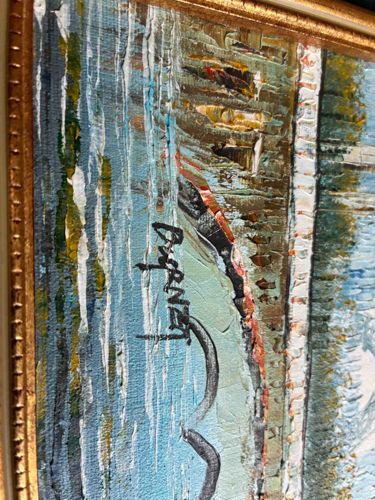
This item is an oil painting on canvas, likely depicting a landscape or waterscape scene given the visible elements. The painting exhibits a vibrant color palette, predominantly featuring blues, greens, and browns, with accents of white and some muted reds. The artist has employed a thick impasto technique, where paint is applied in substantial layers, creating a highly textured surface. This technique contributes to a three-dimensional quality, particularly noticeable in the depiction of what appears to be water or a turbulent sky, and possibly tree trunks or architectural elements. The brushstrokes are broad and visible, indicating a expressive or perhaps impressionistic style. A notable feature is the artist's signature, "BARNET" or similar, written vertically in black paint on the left side of the composition, near what could be a body of water or a reflection. The signature appears to be contemporary with the painting itself, suggesting it was signed upon completion. The painting is housed within a gold-colored, possibly gilded, wooden frame with a decorative outer edge, adding to its presentation. The frame shows no obvious signs of damage from the visible portion. No significant condition issues like cracks, flaking, or major abrasions are discernible in the visible area of the painting. The overall impression is one of good craftsmanship, with the impasto technique suggesting a deliberate artistic choice and adding to the painting's visual interest and perceived quality. The style suggests it could be a mid-20th century to contemporary piece.
AI Appraisal Report
Upon my virtual examination of this oil painting, which appears to be a vibrant impasto landscape or waterscape, I've noted several key elements influencing its valuation. The overall condition, based on the provided image, appears good, with no obvious cracks, flaking, or major abrasions. The thick impasto technique is a defining characteristic, creating significant texture and visual interest, suggesting a deliberate artistic choice rather than a technique issue.
The artist's signature, "BARNET" (or similar) positioned vertically, is a crucial detail. However, without further information, identifying this artist presents a challenge. The style, characterized by broad, visible brushstrokes and a rich color palette, aligns with expressive or impressionistic traditions, placing it potentially from the mid-20th century to contemporary. The ornate gold-colored frame, seemingly in good condition, also adds to its presentation value.
Regarding market conditions, works by unidentified or lesser-known artists, even with good quality and aesthetic appeal, typically command lower prices than those by established artists with extensive exhibition histories or catalogue raisonnés. Demand for landscape/waterscape oil paintings remains consistent, but rarity is difficult to ascertain without knowing the artist's full body of work. The impasto technique itself is popular and can enhance demand.
Factors significantly impacting value here are primarily the lack of artist identification and provenance. While the work presents well aesthetically, the 'BARNET' signature does not immediately call to mind a renowned artist that would command top-tier pricing. The value is therefore largely based on its decorative appeal and execution quality.
My primary limitation in this appraisal is the reliance on images alone. For full authentication and a more precise valuation, an in-person examination is essential to assess the true condition, canvas type, paint consistency, and frame integrity. Provenance documentation (prior ownership, exhibition history) would be invaluable, and scientific testing (e.g., pigment analysis) could further confirm the painting's age and authenticity, potentially linking it to a particular artist or period. Without these, definitive authentication and a higher-tier valuation are speculative.