AI estimate as of September 29, 2025 · verify with a professional before acting
AI-Generated · Verify before acting
Everything on this page is generated by AI for informational purposes only. AI can make mistakes — the AI may misidentify items or misattribute them (artist, maker, brand, designer, origin, era). This is not an official valuation and should not be used for insurance, sale, tax, estate, legal, or lending purposes — or any decision requiring a certified appraisal. It is not an authoritative claim about any person, brand, or rights holder — do not share or rely on it as a factual statement about a third party. Always consult qualified professionals before making financial decisions.
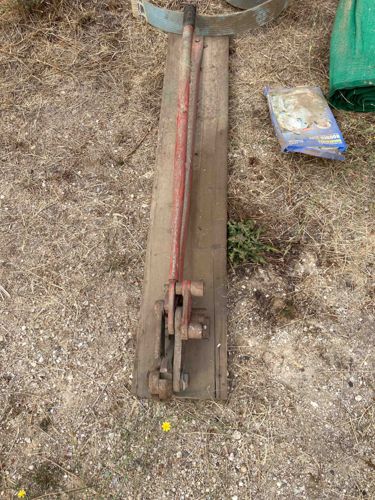
This item appears to be a vintage heavy-duty manual rebar cutter, or bolt cutter specialized for thick materials, resting on a wooden plank. The primary components are constructed from robust metal, likely steel, given its intended function. The main handles, which would be operated by an individual to generate cutting force, are a prominent reddish-orange color, suggesting a past paint application that has faded and accumulated grime over time. These handles are long and tubular or rectangular in cross-section, indicating significant leverage. One handle shows a black-colored grip on its end, likely made of rubber or plastic, which is partially visible. The cutting head mechanism is visible towards the lower end of the handles and is composed of multiple hinged and pivoted metal components, exhibiting a natural, untreated metallic appearance with significant surface rust and dirt, consistent with outdoor storage and age. No specific manufacturer's marks or logos are discernible from the image, but the overall design points to a durable, utilitarian piece of equipment. The construction emphasizes strength and straightforward mechanical advantage, typical of tools from the mid to late 20th century. The condition suggests heavy use and exposure to elements; there is no obvious severe damage like breaks or large dents, but wear, rust, and paint loss are extensive. This item's quality is indicated by its robust, oversized construction, designed for high-force applications.
AI Appraisal Report
Based on my visual examination of the provided image, this vintage heavy-duty manual rebar cutter exhibits characteristics consistent with tools from the mid to late 20th century. Its robust, oversized metal construction, likely steel, speaks to its utilitarian design and intended high-force applications. The reddish-orange paint on the handles, along with significant surface rust, grime, and paint loss on all metallic parts, indicates heavy use and prolonged exposure to the elements. While there are no obvious severe breaks or large dents, the extensive wear confirms a working life rather than a collectible existence. The black grip on one handle is partially visible, but its material (rubber or plastic) and condition cannot be definitively assessed without closer inspection.
Authenticity, as a vintage heavy-duty manual rebar cutter, appears sound based on its design and apparent age. However, without discernible manufacturer's marks or logos, specific brand authentication is impossible from images alone. An in-person examination would be critical to check for hidden markings, assess the integrity of all pivot points and cutting edges, and determine the exact gauge of rebar it's designed to cut, which influences its utility.
In terms of market conditions, these tools, while durable, are no longer state-of-the-art. Modern hydraulic and electric rebar cutters offer greater efficiency and safety. Therefore, the demand for manual cutters like this is generally low, primarily appealing to users with occasional, light-duty needs, or collectors of vintage tools for display. Rarity is not a significant factor; while this specific model might be less common, manual rebar cutters were mass-produced. Factors significantly impacting its value are its working condition (despite heavy wear), its size (indicating heavy-duty capability), and the absence of brand identification.
Considering its condition, lack of specific branding, and the current market for such used manual tools, I estimate its appraisal value to be in the range of $75 to $125. This value reflects its functional potential despite its worn state, rather than any significant collector's premium.