AI estimate as of July 24, 2025 · verify with a professional before acting
AI-Generated · Verify before acting
Everything on this page is generated by AI for informational purposes only. AI can make mistakes — the AI may misidentify items or misattribute them (artist, maker, brand, designer, origin, era). This is not an official valuation and should not be used for insurance, sale, tax, estate, legal, or lending purposes — or any decision requiring a certified appraisal. It is not an authoritative claim about any person, brand, or rights holder — do not share or rely on it as a factual statement about a third party. Always consult qualified professionals before making financial decisions.
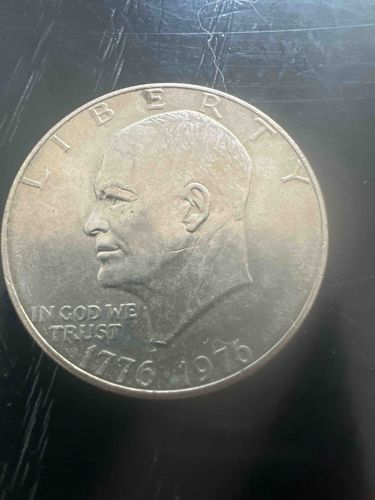
This item is identified as a U.S. Bicentennial Eisenhower Dollar coin, specifically the obverse side. The coin features the bust of Dwight D. Eisenhower in profile, facing left, prominently displayed in the center. Above his head, along the rim, the word "LIBERTY" is inscribed, with each letter clearly visible. Below Eisenhower's bust, the national motto "IN GOD WE TRUST" is distinctly legible. Beneath the motto, the dual bicentennial dates "1776-1976" are embossed, commemorating 200 years of American independence. The coin appears to be made of a silver-colored metal, likely copper-nickel clad or a silver-clad alloy, typical for Eisenhower Dollars. The surface exhibits moderate wear consistent with circulation, particularly noticeable in the softening of details on Eisenhower's hair and facial features. There are visible surface scratches and minor abrasions across the field and the raised elements, indicating handling and use. A slight patina or toning is present, giving the coin a somewhat muted luster rather than a brilliant, uncirculated sheen. No obvious mint mark is discernible on this side, which would typically be located below Eisenhower's neck or near the date. The overall impression is that of a moderately circulated coin from the bicentennial period, with all key design elements intact but showing signs of its age and use.
AI Appraisal Report
Upon examining the provided image of the U.S. Bicentennial Eisenhower Dollar Coin (Obverse), I can conduct a preliminary appraisal. Based on the visual evidence, the coin appears authentic for a circulated Eisenhower Dollar from the Bicentennial issue. The design elements—Eisenhower's bust, "LIBERTY," "IN GOD WE TRUST," and "1776-1976"—are all consistent with known genuine examples. My assessment of its condition, based solely on this image, places it in the Very Fine (VF) to Extremely Fine (EF) range. I observe moderate wear on high points such as Eisenhower's hair and cheekbone, and some softening of detail in the motto and date. The presence of surface scratches, minor abrasions, and a slight patina indicates circulation and handling consistent with its age.
In terms of market conditions, Bicentennial Eisenhower Dollars are generally quite common, having been produced in large quantities. This particular coin, being the copper-nickel clad variety (which is the most prevalent for circulated examples, as a silver-clad alloy would typically show different toning and luster even when circulated), does not possess significant rarity. Demand for circulated examples is relatively low among serious collectors, though they hold sentimental value for many. Comparables in similar circulated condition typically trade for slightly above face value. Factors impacting this coin's value are primarily its circulated condition and the lack of a discernible mint mark (though absence is common for Philadelphia mintages). If this were a Proof or an uncirculated example, or one of the scarcer 40% silver varieties, the value would be significantly higher.
It is crucial to note the limitations of assessing authenticity and condition from an image alone. Without a physical examination, I cannot definitively confirm its metallic composition (e.g., distinguish between copper-nickel clad and a silver-clad variety without a specific gravity test or knowing the exact weight), nor can I fully assess the true extent of wear, luster, or any potential hidden damage. Full authentication would require in-person examination to verify weight, diameter, thickness, metallic composition, and to carefully inspect for any alterations or environmental damage not visible in the image. Provenance documentation would add to its history, but for a common circulated coin like this, it's rarely available or sought after to impact value significantly.