AI estimate as of October 5, 2025 · verify with a professional before acting
AI-Generated · Verify before acting
Everything on this page is generated by AI for informational purposes only. AI can make mistakes — the AI may misidentify items or misattribute them (artist, maker, brand, designer, origin, era). This is not an official valuation and should not be used for insurance, sale, tax, estate, legal, or lending purposes — or any decision requiring a certified appraisal. It is not an authoritative claim about any person, brand, or rights holder — do not share or rely on it as a factual statement about a third party. Always consult qualified professionals before making financial decisions.
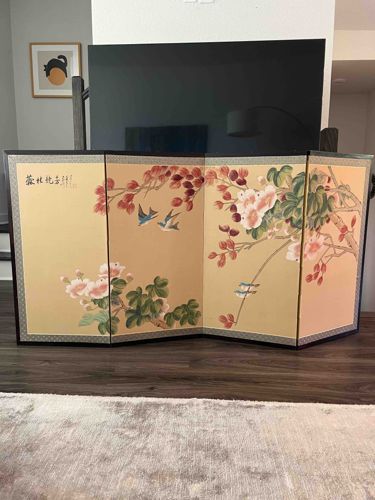
This is a four-panel folding screen, likely of East Asian origin, designed to stand freely or be used as a room divider or decorative accent. Each panel is rectangular and appears to be hinged together, allowing for versatile positioning. The primary decorative surface of the screen features a warm, light yellow or pale gold background color. Against this backdrop, a vibrant hand-painted or printed scene unfolds, depicting flowering branches with soft pink and red blossoms, abundant green foliage, and several small birds in flight or perched. Two blue birds are prominently featured in the central panels, adding a dynamic element to the composition. The style of the artwork suggests traditional East Asian painting techniques, possibly Chinese or Japanese, characterized by delicate brushwork and a naturalistic approach to flora and fauna. On the leftmost panel, there is an area of dark calligraphic writing, which might be a signature, a poem, or an inscription, further indicating its East Asian artistic influence. The framing of each panel is dark, likely wood, and appears to have a subtle textured or patterned border in silver or grey tones, creating a sophisticated edge. The overall construction seems robust, indicating a functional as well as decorative piece. While impossible to determine exact dimensions without scale, it appears to be of a size suitable for a living room or bedroom. The visible condition appears good, with no obvious signs of significant damage, tears, or fading that can be discerned from the image. The colors are rich and well-preserved. This screen likely dates from the 20th century, probably mid to late 20th century, given its relatively good condition and the commonality of such decorative items during that period in interior design. The craftsmanship suggests it is a manufactured decorative item, rather than a unique artisan piece, though the quality of the artwork is commendable.
AI Appraisal Report
I have examined the provided image of this East Asian Style Four-Panel Folding Screen with Floral and Avian Motif. Visually, the screen appears to be in good condition, with vibrant colors, intact artwork, and no obvious signs of significant damage such as tears, major fading, or structural issues. The dark framing with a subtle silver/grey border looks well-preserved. From the image, the craftsmanship suggests a manufactured decorative item, typical of mid to late 20th-century production. The calligraphic writing on the leftmost panel suggests East Asian origin, likely Chinese or Japanese, but without translation or clear stylistic markers, definitive attribution is difficult from an image alone.
In terms of market conditions, folding screens of this style are commonly found in the secondary market. While aesthetically pleasing, they are generally considered decorative furnishings rather than rare antiques. Comparables in similar condition and aesthetic typically range from $300 to $900, depending on size, artistic quality, and specific provenance if available. Demand is generally moderate for such pieces, with value heavily influenced by condition and the perceived quality of the artwork. The naturalistic depiction of flora and fauna is a desirable motif.
Factors impacting value positively include its good apparent condition and attractive composition. However, the lack of definitive artist signature, established provenance, or high-quality materials (e.g., solid rosewood, hand-painted silk) limits its top-tier value. Full authenticity verification regarding age, origin, and whether the artwork is hand-painted versus printed would require in-person examination. Physical inspection would allow me to assess the material quality of the panels, hinges, and frame, examine brushwork detail under magnification (to distinguish hand-painting from print), and analyze the calligraphy accurately. Furthermore, researching any artist signatures or maker's marks would be crucial for a more precise valuation. Without these, the appraisal reflects its decorative value as a well-preserved, attractive East Asian-style screen.