These notes were written by the person who submitted this item. Appraiser.AI has not verified them, and the AI's identification and estimate may rely on them.
AI Estimated Value
Not an official valuation
$400-700
AI estimate as of August 19, 2025 · verify with a professional before acting
AI-Generated · Verify before acting
Everything on this page is generated by AI for informational purposes only. AI can make mistakes — the AI may misidentify items or misattribute them (artist, maker, brand, designer, origin, era). This is not an official valuation and should not be used for insurance, sale, tax, estate, legal, or lending purposes — or any decision requiring a certified appraisal. It is not an authoritative claim about any person, brand, or rights holder — do not share or rely on it as a factual statement about a third party. Always consult qualified professionals before making financial decisions.
This analysis also relies on unverified notes provided by the user, which may be incomplete or inaccurate and could affect the result.
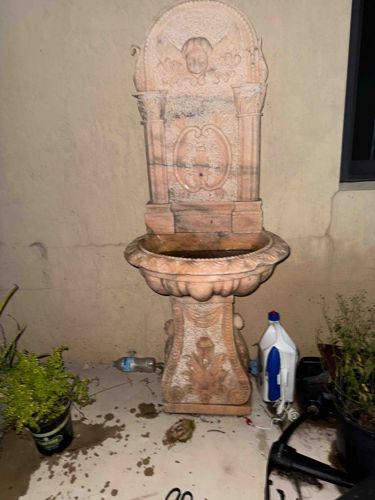
This is a freestanding, antique-style garden fountain, likely constructed from a cast material such as concrete, reconstituted stone, or a resin composite designed to mimic natural stone. It exhibits a predominantly reddish-brown or terracotta hue, consistent with aged or stained cast materials, with visible darker areas suggesting water exposure and patina. The fountain stands about human height and is composed of a back panel or 'stele,' a central basin, and a pedestal base. The back panel is rectangular with a rounded or arched top, featuring classical or baroque ornamentation. At the top, there is a prominent relief sculpture of what appears to be a cherub or putto head with outstretched wings. Below this, the panel is flanked by two stylized columns or pilasters. The central section of the back panel features a decorative medallion or cartouche, which would typically house the water spigot (though not visible or perhaps integrated directly above it). The water collects in a large, scalloped or shell-shaped basin, which features a decorative, molded edge. This basin is supported by a robust pedestal base, also highly ornate, with possibly floral or acanthus leaf motifs sculpted in relief on its sides. Visible condition issues include significant discoloration, dirt, and what appears to be moss or algae growth, particularly within the basin and in recessed areas of the carvings, indicating outdoor exposure and lack of recent cleaning. There are no obvious signs of significant cracking or structural damage from this perspective, but the surface exhibits typical wear and weathering. The overall craftsmanship suggests a mass-produced item designed to evoke an antique or classical aesthetic, characteristic of garden decor from the mid-to-late 20th century, though without a manufacturer's mark, precise dating is difficult. The quality appears good for an outdoor piece, built to withstand elements, and its substantial form suggests durability.
AI Appraisal Report
Upon examining the provided image and description, I've assessed this antique-style garden fountain. It appears to be constructed from a cast material like concrete or reconstituted stone, mimicking classical designs. Its reddish-brown hue and visible patina suggest significant outdoor exposure, consistent with its function. The prominent cherub relief, stylized columns, and scalloped basin point to a mass-produced item aiming for an antique aesthetic, likely from the mid-to-late 20th century.
The condition shows significant signs of weathering, including discoloration, dirt, and notable moss/algae growth, particularly within the basin. While these indicate a lack of recent maintenance, I observe no obvious structural damage or large cracks from this perspective, suggesting good underlying durability. The piece's substantial form further supports its ability to withstand outdoor elements.
From a market perspective, comparable new cast stone or concrete fountains of this size and ornate style typically retail for $800 to $2,000, depending on the manufacturer and detail. Used examples, especially those requiring cleaning and restoration, often fetch less. The demand for such garden ornaments remains steady, driven by homeowners seeking classical focal points. However, pieces like this are not rare; many similar designs are available.
The primary factors impacting its current value are its condition – specifically the extensive surface grime and biological growth – and its probable mass-produced origin. While the aesthetic appeal is present, the lack of a prominent maker's mark or unique artistic quality limits its collectible value to that of a decorative garden feature. Its authenticity as a true antique is highly doubtful based solely on visual cues; it presents as a revival piece. For definitive authentication of age or material composition, an in-person examination, material testing, and provenance documentation (e.g., original purchase receipts, historical photos) would be crucial. Without these, the 'antique' aspect is purely stylistic.