AI estimate as of September 26, 2025 · verify with a professional before acting
AI-Generated · Verify before acting
Everything on this page is generated by AI for informational purposes only. AI can make mistakes — the AI may misidentify items or misattribute them (artist, maker, brand, designer, origin, era). This is not an official valuation and should not be used for insurance, sale, tax, estate, legal, or lending purposes — or any decision requiring a certified appraisal. It is not an authoritative claim about any person, brand, or rights holder — do not share or rely on it as a factual statement about a third party. Always consult qualified professionals before making financial decisions.
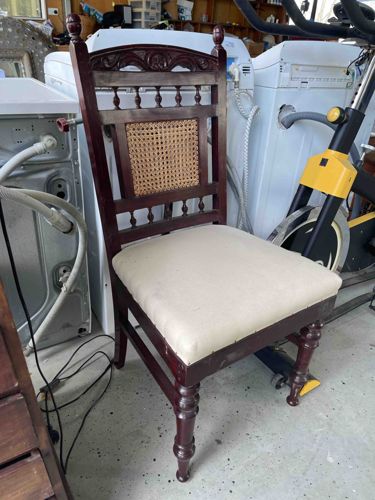
This is a single chair crafted from dark-stained wood, likely mahogany or a similar hardwood, exhibiting characteristics of Victorian-era design, possibly from the late 19th or early 20th century. The chair features an elaborately carved crest rail at the top of the backrest, showcasing fanned shell motifs and scrolling foliage. Below the crest rail, there is a section of turned spindles, adding to its decorative appeal. A prominent feature of the backrest is a rectangular panel of tightly woven cane, providing a breathable and somewhat flexible surface. The back stiles extend upwards, terminating in decorative finials, which appear to be turned or carved. The seat is an upholstered cushion covered in what appears to be a light-colored, possibly off-white or beige, plain fabric, showing some signs of use and minor discoloration consistent with age and handling. The upholstery is attached with visible tacks along the perimeter, though they are not clearly discernible in detail. The legs are turned, showcasing a bulbous or baluster form, tapering towards the feet. There are signs of wear and tear, including scuffs and scratches on the wooden frame, particularly on the legs and edges, indicating its age and usage. The dark stain has some areas of fading or rubbing, revealing lighter wood beneath in certain spots. The overall construction appears sturdy, suggesting good craftsmanship despite the visible wear. There are no obvious breaks or major repairs visible in the provided image, though a more thorough inspection would be required for a complete condition assessment. The chair's aesthetic combines classical carving with functional caning and upholstery, typical of furniture designed for comfort and elegance during its era.
AI Appraisal Report
Based on my visual examination of the provided image, this Victorian-style carved and caned dining chair appears to be a genuine piece from the late 19th or early 20th century. The elaborate fanned shell and scrolling foliage carvings on the crest rail, turned spindles, and baluster-form legs are consistent with design elements prevalent during the Victorian era. The presence of a hand-woven cane panel in the backrest and upholstered seat secured with visible tacks further supports this dating.
Condition-wise, the chair shows significant signs of age and use, including scuffs, scratches, and areas of fading/rubbing on the dark-stained wooden frame. The upholstered seat, while functional, exhibits minor discoloration, suggesting it may be original or an early reupholstery. While the overall construction appears sturdy, these cosmetic imperfections, along with the visible wear, place it in 'good' vintage condition rather than 'excellent' or 'fine.'
Market conditions for single Victorian dining chairs like this are moderate. While there's a niche market for period furniture, individual chairs, especially if not part of a complete set or particularly rare, often command lower values. Comparables in similar condition typically fall within the $100-250 range at auction or vintage furniture stores. The demand for such pieces is present but not robust, and rarity is not a significant factor here as this style was mass-produced.
Factors significantly impacting value are primarily its condition and the fact it's a single chair. A full set in better condition would command a much higher per-chair value. The visible wear reduces its appeal to collectors seeking pristine examples.
It is important to note that this assessment is based solely on visual inspection of the image. For full authentication and a definitive condition report, an in-person examination is crucial. This would allow me to verify the wood species, assess the integrity of all joints and carvings, inspect the cane for any hidden damage, and determine if the upholstery is original or a later replacement. Provenance documentation, though unlikely for a single chair of this type, would also confirm age and history.