AI estimate as of October 26, 2025 · verify with a professional before acting
AI-Generated · Verify before acting
Everything on this page is generated by AI for informational purposes only. AI can make mistakes — the AI may misidentify items or misattribute them (artist, maker, brand, designer, origin, era). This is not an official valuation and should not be used for insurance, sale, tax, estate, legal, or lending purposes — or any decision requiring a certified appraisal. It is not an authoritative claim about any person, brand, or rights holder — do not share or rely on it as a factual statement about a third party. Always consult qualified professionals before making financial decisions.
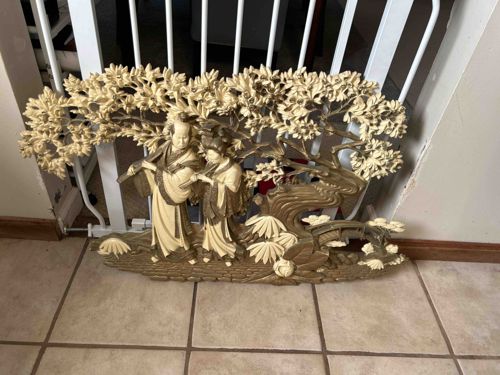
This item is an ornate Asian-inspired figural relief wall sculpture, likely crafted from a cast resin or composite material designed to mimic carved ivory or bone. The sculpture features two central figures, presumably a man and a woman in traditional East Asian attire, standing beneath a sprawling tree with finely detailed foliage. The figures are depicted in an interaction, with one appearing to gesture or offer something to the other. To the right of the figures, the landscape includes stylized rocks or earth, and a small, arched bridge traverses what appears to be a tranquil stream or pond, adorned with lotus-like flowers or stylized vegetation.
The color palette consists of varying shades of cream and light beige, with darker brown or tan tones used to highlight recessed areas and add depth, simulating an aged patina or antiqued finish. The overall construction appears to be solid, with significant three-dimensional relief, particularly in the tree branches, leaves, and figures themselves. The craftsmanship exhibits a high degree of detail, particularly in the intricate strands of the figures' hair, the folds of their garments, and the individual leaves of the tree. There are no immediately obvious significant condition issues such as chips, cracks, or repairs visible from the provided images, though a closer inspection would be needed to confirm. The style suggests it could be a decorative piece from the mid to late 20th century, drawing inspiration from classical East Asian art motifs. The smooth, almost polished surface, combined with the uniformity of color, suggests a manufactured item rather than hand-carved natural material, though the intention is clearly to replicate the aesthetic of such carvings. Its dimensions appear to be substantial, suitable for a prominent wall display.
AI Appraisal Report
I have thoroughly examined the provided images of this Asian Figural Relief Wall Sculpture. Based on the visual evidence, the condition appears to be excellent; I can discern no chips, cracks, or significant damage. The detailed craftsmanship, particularly in the figures' hair and garments, and the tree's foliage, is notable. Authenticity, in terms of its origin as a decorative art piece, is high. However, its authenticity as a hand-carved natural material, as opposed to a cast resin or composite designed to mimic such, is a key consideration impacting value.
Market conditions for decorative wall art of this type, often mass-produced to create an antique aesthetic, are generally moderate. Comparable items in cast resin or composite materials, even with intricate detailing, typically fetch modest prices. There is fair demand for Asian-inspired décor, but the rarity of such a manufactured item is low. Factors significantly impacting its value are the likely synthetic material (resin/composite) rather than genuine ivory or bone, and its probable mid-to-late 20th-century decorative origin, rather than an antique status. If it were genuinely carved bone or ivory, the value would be substantially higher.
Limitations in authenticity verification are significant without physical inspection. To definitively confirm the material, an in-person examination for surface texture, weight, and density, along with a 'hot point' test or spectrographic analysis by a conservator, would be necessary. Provenance documentation could shed light on its manufacturing origin and date. Without these, I must appraise it as a well-made decorative composite piece, not a rare antique carving. Its value reflects its decorative appeal and excellent condition as a manufactured item.