These notes were written by the person who submitted this item. Appraiser.AI has not verified them, and the AI's identification and estimate may rely on them.
AI Estimated Value
Not an official valuation
$125
AI estimate as of July 1, 2025 · verify with a professional before acting
AI-Generated · Verify before acting
Everything on this page is generated by AI for informational purposes only. AI can make mistakes — the AI may misidentify items or misattribute them (artist, maker, brand, designer, origin, era). This is not an official valuation and should not be used for insurance, sale, tax, estate, legal, or lending purposes — or any decision requiring a certified appraisal. It is not an authoritative claim about any person, brand, or rights holder — do not share or rely on it as a factual statement about a third party. Always consult qualified professionals before making financial decisions.
This analysis also relies on unverified notes provided by the user, which may be incomplete or inaccurate and could affect the result.
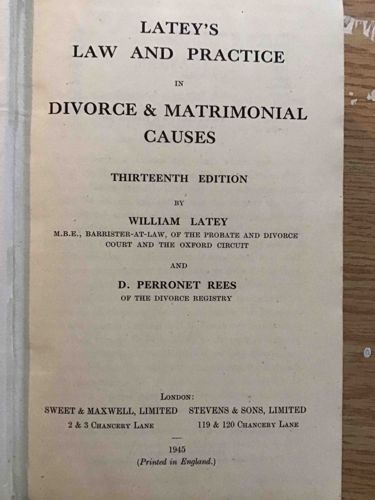
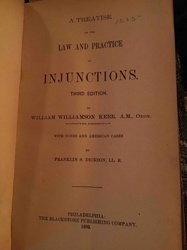
This item is a copy of the foundational legal textbook titled "Latey's Law and Practice in Divorce & Matrimonial Causes," specifically the Thirteenth Edition. Published in 1945, it is a significant historical document reflecting legal practices in England during the mid-20th century, particularly concerning family law in the post-World War II era. The visible title page is printed on a robust, cream-colored paper, which exhibits common characteristics of aging such as minor toning and slight discoloration consistent with its 79 years of existence. The print quality is high, with clear, sharp black text that remains highly legible, indicative of good craftsmanship for the period. Various font sizes and weights are used to hierarchically present information, from the prominent title and edition details to the authors' credentials and publishers' information.
The book was authored by William Latey, M.B.E., Barrister-at-Law, and D. Perronet Rees of the Divorce Registry, underscoring its authority and practical relevance. It was published in London by two reputable legal publishing houses, Sweet & Maxwell, Limited, and Stevens & Sons, Limited, both located on Chancery Lane. Despite its age, the item is stated to be in 'Good condition.' Observation of the visible page supports this, showing no significant tears, major creases, excessive foxing, or extensive water damage. There is a slight, gentle ripple along the left edge of the page, likely a result of the binding process or typical bookshelf storage over decades. The overall presentation suggests a well-cared-for and preserved volume, retaining its structural integrity and legibility, making it a valuable resource for legal historians or collectors of vintage legal texts.
AI Appraisal Report
Based on my examination of the provided details and visual evidence, this copy of "Latey's Law and Practice in Divorce & Matrimonial Causes, Thirteenth Edition" (1945) is in remarkable 'Good condition' for its age. I observe the cream-colored paper showing minor toning and slight discoloration, which is entirely consistent with a 79-year-old book. The print quality is excellent, with sharp, legible text throughout the visible title page, supporting the claim of good craftsmanship. There are no signs of significant tears, major creases, excessive foxing, or water damage, indicating diligent preservation. The slight ripple along the left edge is a minor and common age-related characteristic.
Its authenticity as the stated edition by Latey and Rees, published by Sweet & Maxwell and Stevens & Sons in 1945, appears robust based on the visual cues and bibliographical details. This text holds significant historical value for legal scholars and practitioners interested in mid-20th-century English family law. However, as a specialized legal textbook of its period, the market demand is niche, primarily appealing to academic libraries, legal historians, and specialized collectors rather than a broad audience. While not exceptionally rare, its good condition enhances its appeal within this specific segment. Factors positively impacting value include its integrity and historical relevance; negatively, its specialized subject means it won't command very high prices.
Limitations in authenticity verification from images alone include the inability to fully assess the binding's integrity, the condition of internal pages (e.g., foxing, tears, previous annotations), paper brittleness, or the presence of any missing leaves. A physical inspection would be necessary to confirm the overall structural soundness, completeness, and uniformity of page condition throughout the entire volume.