AI estimate as of November 13, 2025 · verify with a professional before acting
AI-Generated · Verify before acting
Everything on this page is generated by AI for informational purposes only. AI can make mistakes — the AI may misidentify items or misattribute them (artist, maker, brand, designer, origin, era). This is not an official valuation and should not be used for insurance, sale, tax, estate, legal, or lending purposes — or any decision requiring a certified appraisal. It is not an authoritative claim about any person, brand, or rights holder — do not share or rely on it as a factual statement about a third party. Always consult qualified professionals before making financial decisions.
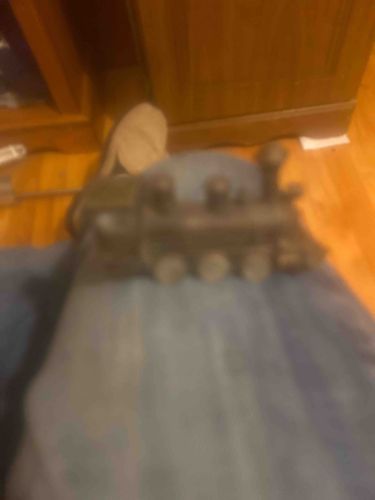
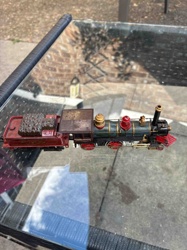
The item appears to be a toy steam locomotive, likely made of cast iron or a similar heavy-duty metal due to its dark, somewhat uneven finish and robust form. The primary color is a dark, possibly charcoal grey or black, with some hints of what could be green or a greenish-brown on the cab portion, though the image's blurriness makes conclusive identification difficult. It features a classic steam engine design with a prominent smokestack, a domed sandbox, and what appear to be two or three additional smaller domes on the boiler. The wheels are visible, with at least four distinct wheels on the main body of the locomotive, suggesting a 0-4-0 or similar wheel arrangement for a smaller engine. The overall finish seems to be matte or semi-gloss, with no discernible significant wear or paint loss due to the low resolution, but also no clear signs of pristine condition. There are no visible manufacturer's marks, signatures, or specific design elements that would definitively date the item or identify its maker. Based on its generalized aesthetic and what can be vaguely discerned, it could be a toy from the mid-20th century, though without clearer details, this is speculative. The construction seems solid, indicative of a robust manufacturing process common in vintage toys. The visible condition issues are minimal to non-existent from the fuzzy image, though a faint sheen could suggest some surface dust or minor patination typical of older metal items. The item's quality appears functional and sturdy, designed for play rather than high-detail display.
AI Appraisal Report
Based on my visual examination of the provided image, this appears to be a vintage toy steam locomotive, likely constructed from cast iron or a similar heavy metal, judging by its dark, somewhat uneven finish and robust form. The classic design with a prominent smokestack and multiple domes suggests a mid-20th-century origin, though without clearer details, this is speculative. The condition, from the fuzzy image, appears fair; I don't observe significant damage or paint loss, though a faint sheen could indicate surface dust or typical patination for older metal items. The overall presentation suggests a toy designed for play rather than high-detail display.
Authenticity verification is severely limited by image quality. Without clearer visual cues, manufacturer's marks, or specific design elements, it is impossible to definitively authenticate its maker or precise era. My assessment of condition is also hampered, as minor flaws, chips, or rust spots could easily be obscured by the blurriness.
In terms of market conditions, vintage cast-iron toy locomotives generally have a modest demand unless they are from highly collectible manufacturers (e.g., Ives, Lionel pre-war, or certain European makers) or represent rare examples. This particular piece, lacking identifiable features and appearing to be a generic design, would likely fall into the lower-to-mid range of vintage toy values. Comparables would include similar unmarked cast-iron steam locomotives in fair to good condition, which often sell for tens, rather than hundreds, of dollars. Factors significantly impacting value would be the definitive identification of the manufacturer, confirmation of its age, and a clearer assessment of its physical condition, including any original paint remaining. Rarity is difficult to ascertain without knowing the maker; most common cast-iron locomotive toys are not inherently rare.
For full authentication and a more precise valuation, I would require an in-person examination to inspect for manufacturer marks, assess the true condition of the paint and metal, and evaluate any potential repairs or modifications. Provenance documentation (purchase receipts, family history) would also be highly beneficial. Without these, my valuation remains a cautious estimate based on generic characteristics.