AI estimate as of July 13, 2025 · verify with a professional before acting
AI-Generated · Verify before acting
Everything on this page is generated by AI for informational purposes only. AI can make mistakes — the AI may misidentify items or misattribute them (artist, maker, brand, designer, origin, era). This is not an official valuation and should not be used for insurance, sale, tax, estate, legal, or lending purposes — or any decision requiring a certified appraisal. It is not an authoritative claim about any person, brand, or rights holder — do not share or rely on it as a factual statement about a third party. Always consult qualified professionals before making financial decisions.
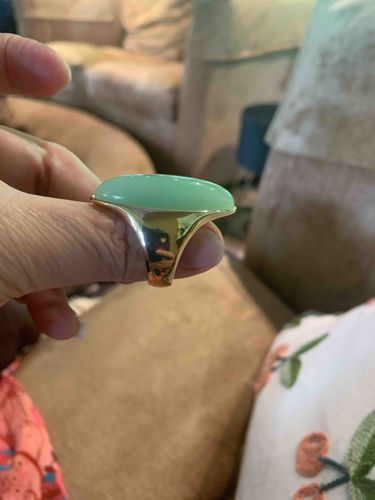
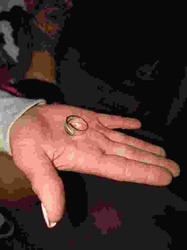
This item is a ring featuring a prominent cabochon-cut gemstone set in a polished gold-toned metal band. The central gem is an elongated oval shape, presenting a striking pale green, almost pistachio or celadon, color with a milky translucence. Its surface is smooth and domed, characteristic of a cabochon cut, which maximizes the visual effect of the stone's color and sheen. The gem appears to be securely bezel-set within the metalwork, with the gold-toned rim framing its entirety. The metal band itself is wide and tapers towards the bottom, exhibiting a high polish that reflects light, suggesting it could be yellow gold or a gold-plated base metal. The overall design is clean and minimalist, highlighting the gemstone. There are no visible prominent inclusions or flaws within the stone from this perspective, nor are there any obvious chips or cracks. The metal shows some surface reflections and possibly minor handling marks consistent with wear, but no significant scratches, dents, or signs of repair are immediately discernible. The ring style suggests a contemporary or mid-20th century aesthetic, leaning towards a cocktail ring or a statement piece due to the size of the gemstone. The craftsmanship appears solid, with a well-finished setting that securely holds the stone. The quality of the gemstone's cut, being smooth and evenly domed, indicates good execution. No maker's marks or distinguishing hallmarks are visible in the provided image.
AI Appraisal Report
Upon visual examination of the provided image, I assess this Cabochon Green Gemstone Ring to be in very good overall condition. The prominent cabochon-cut gemstone exhibits a pleasing pale green hue and milky translucence, characteristic of materials like chrysoprase, prehnite, or even a specific variety of chalcedony. Its smooth, domed surface appears free of significant inclusions, chips, or cracks, indicating good preservation. The bezel setting securely holds the stone, and the polished gold-toned metal band shows minor surface reflections consistent with gentle wear, but no major scratches, dents, or signs of repair.
Authenticity of the gemstone type and metal composition cannot be definitively confirmed without in-person examination or testing. While the metal has the appearance of yellow gold, it could be gold-plated base metal, which would significantly impact value. Similarly, without hands-on inspection, I cannot confirm if the gemstone is natural or synthetic, or its specific geological origin.
Market conditions for cabochon rings, particularly those featuring aesthetically pleasing green stones, are generally stable, driven by a consistent demand for unique statement pieces. Comparables would include vintage or contemporary rings crafted from similar materials. The lack of visible hallmarks or maker's marks, while not uncommon, limits positive identification of a specific designer or origin.
The primary factors affecting value are the true identity of the green gemstone (e.g., natural chrysoprase versus a less valuable green chalcedony or synthetic) and the metal composition (solid gold versus gold-plated). Rarity is moderate; while cabochon rings are not exceedingly rare, a well-executed design with a desirable stone always finds a market.
For full authentication and a more precise valuation, it would be essential to conduct a physical examination to test the metal purity (e.g., acid test, XRF analysis) and gemological testing of the stone (e.g., refractive index, specific gravity, magnification for inclusions) to ascertain its species and natural origin. Provenance documentation, if available, would also add to its verifiable history and value.