AI Appraisal Estimate

AI-generated estimates · not official valuations

From the user

What was submitted

Photo and notes provided by the user — not generated by AI

Submitted item photo
Submitted photo · June 6, 2026

User's notes

No additional notes provided.

AI analysis below

AI appraisal

AI analysis & estimate

AI-Generated · Verify before acting

Everything below is generated by AI for informational purposes only. AI can make mistakes — the AI may misidentify items or misattribute them (artist, maker, brand, designer, origin, era). This is not an official valuation and should not be used for insurance, sale, tax, estate, legal, or lending purposes — or any decision requiring a certified appraisal. It is not an authoritative claim about any person, brand, or rights holder — do not share or rely on it as a factual statement about a third party. Always consult qualified professionals before making financial decisions.

Read the full disclaimer

AI Identification

·Not independently authenticated·Verify before acting

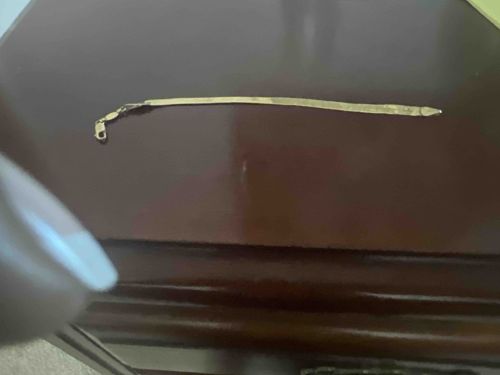
Gold Herringbone Chain

Jewelry

AI Estimated Value

·Not an official valuation·Verify before acting

$50 - $150

As of June 6, 2026

AI Item Analysis

·AI can make mistakes·Verify before acting
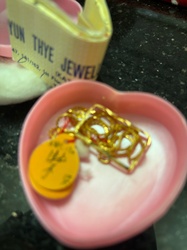
The item is a gold-colored flat chain, most likely part of a bracelet or necklace, specifically an Italian-style 'herringbone' chain. The material appears to be a yellow metal, presumably gold or gold-plated, given its characteristic luster and color. The chain is relatively thin and flexible, consistent with a herringbone design where V-shaped links are interlocked to lie flat. At one end, there is a functional clasp, which appears to be a spring ring or similar mechanism, indicating it's intended for wear as jewelry. The other end terminates abruptly, suggesting the chain may be broken or incomplete. There are visible signs of wear and possible damage, particularly near the fractured end, where the chain appears to be bent or kinked, which is a common issue with herringbone chains. The color is uniform, a bright yellow gold, with no obvious discoloration or tarnish visible from the image. No distinct maker's marks, hallmarks, or signatures are discernible in the provided images. The style indicates a modern or contemporary piece, likely from the late 20th to early 21st century. The craftsmanship appears to be standard for mass-produced jewelry of this type, with tightly interlocked links that give it a smooth, reflective surface when intact. The current condition, particularly the breakage, is a significant factor in its present state.
AI Appraisal Report

·AI can make mistakes·Verify before acting
Based on my visual examination of the provided image, I assess this gold-colored herringbone chain. Authenticity of the material, gold vs. gold-plated, cannot be definitively determined from images alone. The uniform bright yellow color suggests it could be gold, but it is equally plausible it is gold-plated base metal, which is common for this style. I observe significant condition issues: the chain is broken, indicated by the abrupt termination and kinking at one end. Herringbone chains are notoriously fragile and prone to kinking and breaking, which severely impacts their value. The visible clasp at the other end appears functional. Market conditions for broken or incomplete herringbone chains are generally low. If it were solid gold, its value would primarily be its scrap weight. However, without a hallmark or testing, I cannot confirm it's solid gold. If it's gold-plated, its value is negligible. There is no rarity to this item; herringbone chains were mass-produced. Demand for a broken chain of unknown material is minimal. Factors significantly impacting value are the breakage and the inability to verify material composition. Its current state would require significant repair if it were to be worn again, adding to the cost. Lack of maker's marks also limits potential collector value. Limitations are significant: I cannot confirm material (gold vs. gold-plated), caratage if gold, or actual weight. For full authentication and accurate valuation, an in-person examination is crucial. This would involve specific gravity testing, acid testing or XRF analysis to determine metal composition, and weighing the item. Additionally, a closer inspection could reveal any faint hallmarks not visible in the image. Provenance documentation, if available, would also aid in confirming its origin and material if it were a high-value piece, which this style typically is not.

Get your items appraised

Instant estimates of your treasures with AI-powered appraisals

Browse More Appraisals