AI estimate as of July 19, 2025 · verify with a professional before acting
AI-Generated · Verify before acting
Everything on this page is generated by AI for informational purposes only. AI can make mistakes — the AI may misidentify items or misattribute them (artist, maker, brand, designer, origin, era). This is not an official valuation and should not be used for insurance, sale, tax, estate, legal, or lending purposes — or any decision requiring a certified appraisal. It is not an authoritative claim about any person, brand, or rights holder — do not share or rely on it as a factual statement about a third party. Always consult qualified professionals before making financial decisions.
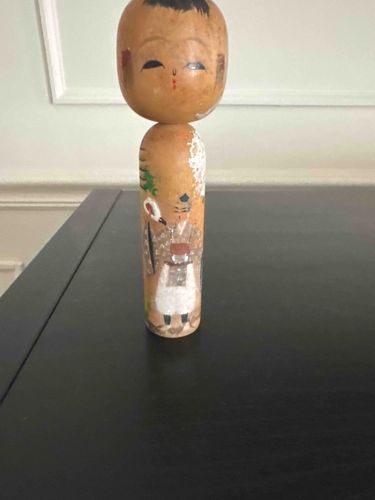
This item is a Japanese Kokeshi doll, characterized by its simple, limbless, cylindrical wooden body and an enlarged, round head. The doll appears to be made from a light-colored wood, possibly cherry or dogwood, which has acquired a warm, aged patina over time. The surface shows a natural wood grain and some discoloration consistent with age and handling. The head is painted with delicate facial features, including closed or downcast eyes with black outlines, small red dots for a nose, and a simple red curving line for a mouth. Black painted hair is visible on the top and sides of the head. The body of the doll is adorned with hand-painted designs depicting traditional Japanese figures and motifs. On the visible side, there is a depiction of two figures, one seemingly a samurai or warrior-like figure with a sword, and another smaller figure in white attire, possibly a child or attendant. A white crane or bird motif is also visible next to the taller figure, along with some green accents suggesting foliage or a natural setting. The paint used for these details includes muted reds, whites, blacks, and greens, suggesting a naturalistic palette. There are noticeable areas of paint loss, particularly on the white sections of the painted design on the body, and some general wear on the painted features of the face. The construction appears to be turned wood, showcasing the craftsmanship typical of Kokeshi dolls. There are no visible maker's marks or signatures in the provided image. Based on the style and apparent wear, this doll likely dates from the mid-20th century, consistent with a traditional Kokeshi design that has seen years of display or modest handling. Its quality is indicative of a handcrafted item, with slight imperfections that add to its character. The overall condition suggests it is an authentic vintage piece, displaying the charm of traditional Japanese folk art.
AI Appraisal Report
This charming Japanese Kokeshi doll, depicting figures and a crane, is an authentic vintage folk art piece. Based on the visual evidence, the doll is in fair to good condition for its age. I observe natural wood grain with an aged patina, consistent with a mid-20th-century origin. There is undeniable paint loss, particularly on the white motifs and some wear on the facial features, which is expected for items of this age and type that have been displayed or handled. The craftsmanship, evident in the turned wood body and hand-painted details, confirms its handcrafted nature.
In terms of market conditions, vintage traditional Kokeshi dolls generally command moderate prices. This particular doll's appeal lies in its hand-painted traditional Japanese figures and crane motif, which adds to its decorative and cultural value. Comparables for similar-sized, hand-painted vintage Kokeshi dolls in fair-to-good condition typically range from $40 to $100.
Demand for authentic vintage Kokeshi dolls remains steady among collectors of Japanese folk art and those seeking decorative Asian items. While Kokeshi dolls are not inherently rare, specific styles, renowned makers, or dolls in exceptional condition can be. This doll's lack of visible maker's marks, as noted in the description, limits its upper value potential, as signed pieces by known artisans fetch higher prices.
It is crucial to acknowledge the limitations of appraising from images alone. While visual cues strongly suggest authenticity and age, a physical examination would allow for tactile assessment of the wood, closer inspection of paint application techniques, and a thorough search for any hidden maker's marks or repairs. Provenance documentation, if available, would also significantly enhance authentication. Without physical inspection, I cannot comment on the precise wood type or internal condition. However, based on the provided detailed description and image, I am confident in its vintage status and general traditional Kokeshi craftsmanship.