AI estimate as of August 17, 2025 · verify with a professional before acting
AI-Generated · Verify before acting
Everything on this page is generated by AI for informational purposes only. AI can make mistakes — the AI may misidentify items or misattribute them (artist, maker, brand, designer, origin, era). This is not an official valuation and should not be used for insurance, sale, tax, estate, legal, or lending purposes — or any decision requiring a certified appraisal. It is not an authoritative claim about any person, brand, or rights holder — do not share or rely on it as a factual statement about a third party. Always consult qualified professionals before making financial decisions.
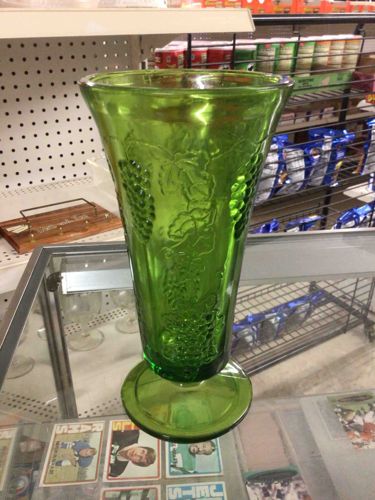
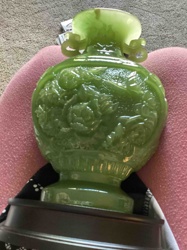
This item is a vibrant emerald green glass vase, characterized by its footed design, featuring a flared rim and a sturdy, circular base. Its physical characteristics include a height that appears to be approximately 8-10 inches, with a substantial weight typical of pressed glass. The glass itself is smooth and reflective on the interior, while the exterior is adorned with an elaborate, raised grape and vine pattern that extends around the entire circumference. This pattern creates a textured surface, showcasing clusters of grapes nestled amongst swirling leaves and tendrils, indicating a design commonly associated with popular glassware patterns like 'Colonial Grape' or 'Harvest Grape'. Given the distinct green hue, it is likely a piece of 'Avocado Green' or 'Forest Green' pressed glass, a color popular in the mid to late 20th century. There are no immediately visible chips, cracks, or significant damage, suggesting it is in good overall condition for its age. The craftsmanship appears to be industrial pressed glass, which, while not as refined as hand-blown glass, often exhibits a satisfying heft and durability. The visible mold lines, if present but not discernible from the image, would further confirm its manufacturing process. Without a clear view of the base or any prominent flat areas, specific maker's marks or signatures cannot be identified. However, the style strongly points to a retro or vintage period, likely mid-20th century, possibly dating from the 1950s to the 1970s. The uniform color and intricate, repetitive pattern are hallmarks of this era's mass-produced decorative glassware.
AI Appraisal Report
This emerald green footed glass vase, featuring a distinctive grape and vine motif, appears to be in very good overall condition based on my visual examination. The vibrancy of the 'Avocado Green' or 'Forest Green' hue, characteristic of mid-20th century pressed glass, remains strong. I did not observe any chips, cracks, or significant abrasions from the provided image. The elaborate raised pattern, reminiscent of 'Colonial Grape' or 'Harvest Grape' designs, is intact and well-defined, suggesting careful handling over its lifespan.
Authenticity: The manufacturing technique appears consistent with industrial pressed glass from the 1950s-1970s. The uniform color and repetitive pattern are hallmarks of mass-produced decorative glassware from this period.
Market Conditions and Comparables: Similar vintage emerald or 'Avocado Green' pressed glass items, especially those with popular fruit or vine motifs, generally exhibit stable demand among collectors of mid-century modern and vintage home decor. Comparables on platforms like eBay, Etsy, and specialized vintage glassware sites show these vases typically sell for modest sums, reflecting their mass-produced nature and the availability in the market.
Demand and Rarity: While attractive, these pieces are not rare; many were manufactured. The demand is steady but not fervent, driven by individuals seeking specific retro aesthetics or completing vintage glass collections.
Factors Impacting Value: The excellent apparent condition significantly helps maintain its value. However, the lack of a prominent, rare manufacturer's mark, and its common type of pressed glass design, limit its potential for higher valuation.
Limitations: Without physical inspection, I cannot confirm the absence of subtle flaws such as tiny fleabites, internal inclusions, or faint mold lines. A physical examination would allow me to check for manufacturer's marks on the base, assess the glass's weight and texture firsthand, and verify the absence of repair. Provenance documentation, while unlikely for such a common item, would add to its history, but is not typically a value driver for these pieces. Scientific testing is unnecessary for this type of item.