AI estimate as of August 9, 2025 · verify with a professional before acting
AI-Generated · Verify before acting
Everything on this page is generated by AI for informational purposes only. AI can make mistakes — the AI may misidentify items or misattribute them (artist, maker, brand, designer, origin, era). This is not an official valuation and should not be used for insurance, sale, tax, estate, legal, or lending purposes — or any decision requiring a certified appraisal. It is not an authoritative claim about any person, brand, or rights holder — do not share or rely on it as a factual statement about a third party. Always consult qualified professionals before making financial decisions.
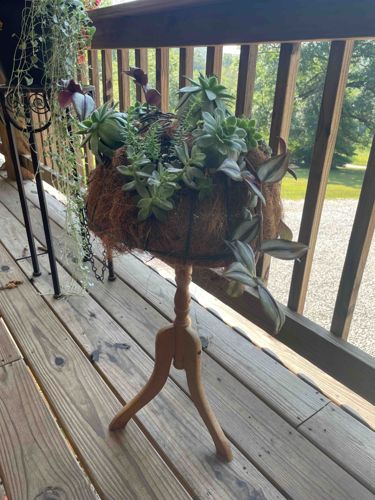
This item is a decorative floor planter arrangement, comprising a natural fiber, likely coco coir or similar, hanging basket liner overflowing with an assortment of live succulent plants, set atop a light-colored wooden pedestal stand. The basket liner appears to be a rounded, somewhat irregular shape, possibly formed from a wire frame covered in dense coco coir, giving it a rustic, organic texture and a warm brown color. There are visible dark cords or wires, possibly to reinforce the liner or for hanging purposes, though it is currently unsupported by these. The succulents vary in size, shape, and color, including several rosette-forming types (likely Echeveria or Sempervivum), some spikier varieties, and a trailing plant with striped leaves (possibly Tradescantia). The plants exhibit good health and vibrancy, with no obvious signs of wilting or disease. The wooden stand is crafted from a light, natural wood, possibly pine or maple, with a smooth, possibly unfinished or lightly sealed surface. It features a turned central column with a bulbous detail near the top, transitioning into a tripod base with three gracefully curved, splayed legs. The construction appears to be machine-made, indicating a modern or mass-produced origin, rather than handcrafted antiquity. No visible manufacturing marks, signatures, or obvious condition issues such as cracks, chips, or significant wear are discernible on the stand or basket, suggesting it is relatively new or well-maintained. The ensemble is designed to be a standalone decorative piece, likely for indoor or sheltered outdoor use, given the nature of the wood and plants. The overall aesthetic is natural and contemporary, fitting well into various decor styles. The quality of both the plants and the stand appears good, indicating a functional and aesthetically pleasing garden decor item.
AI Appraisal Report
Upon visual examination of the provided image, this Succulent Floor Planter with Wooden Pedestal Stand presents itself as a well-maintained, contemporary decorative item. The condition of both the succulent arrangement and the wooden stand appears excellent; the plants are vibrant and healthy with no visible signs of distress, and the stand shows no chips, cracks, or significant wear. This suggests either a relatively new item or one that has been meticulously cared for.
From the image, the plants appear to be common succulent varieties, likely Echeveria, Sempervivum, and Tradescantia, which are widely available and relatively easy to propagate. The wooden stand, with its turned column and tripod base, is machine-made, indicative of modern mass production rather than artisanal craftsmanship or antique origin. This affects its valuation, as mass-produced items generally hold less intrinsic value than unique or historically significant pieces.
The demand for succulent arrangements and modern garden decor is currently strong, driven by interior design trends emphasizing natural elements and low-maintenance plants. However, the market is also saturated with similar items, especially those utilizing common plant species and mass-produced components. Rarity is not a factor here; comparable items can be found readily at home goods stores, nurseries, and online retailers. The primary value drivers are the aesthetic appeal and the healthy condition of the plants.
Limitations to authenticity verification exist due to the image-only examination. I cannot definitively assess the exact species of succulents, confirm their long-term health beyond the current visual, or verify the wood type and finish quality without physical inspection. An in-person examination would allow for a tactile assessment of the stand's material, a closer inspection of the plant roots and pest presence, and a more precise identification of plant varieties, which could slightly influence the market value based on specificity and desirability. Provenance documentation would not significantly alter the value of such a mass-market item.
Considering these factors, the item represents a functional and attractive piece of modern home decor rather than a valuable collectible.