AI estimate as of September 19, 2025 · verify with a professional before acting
AI-Generated · Verify before acting
Everything on this page is generated by AI for informational purposes only. AI can make mistakes — the AI may misidentify items or misattribute them (artist, maker, brand, designer, origin, era). This is not an official valuation and should not be used for insurance, sale, tax, estate, legal, or lending purposes — or any decision requiring a certified appraisal. It is not an authoritative claim about any person, brand, or rights holder — do not share or rely on it as a factual statement about a third party. Always consult qualified professionals before making financial decisions.
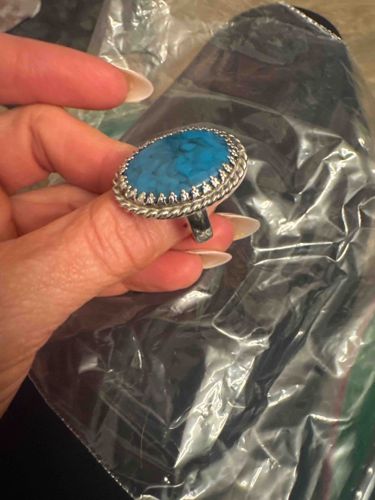
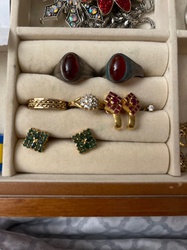
This item is an oval-shaped ring featuring a prominent turquoise cabochon stone set in what appears to be sterling silver. The central turquoise stone exhibits a vibrant 'robin's egg blue' color with visible dark matrix veining, indicative of natural turquoise. The stone is cut into a smooth, polished oval cabochon shape. Surrounding the turquoise is an ornate bezel setting with a serrated or 'sawtooth' edge, which firmly holds the stone in place. This bezel is then encircled by a braided or twisted wire detail, adding texture and craftsmanship to the design. Beyond the braided element, there is another beaded or dot-like pattern, further enhancing the decorative aspect of the setting. The ring band, visible only in part, appears to be made of the same silver-toned metal, possibly sterling silver, and shows some signs of wear and tarnishing, particularly on the underside or shank. The style suggests a Southwestern or Native American craftsmanship influence, common for turquoise jewelry. While no maker's marks or signatures are visible in the provided image, the intricate silverwork points to a handmade or artisan-crafted piece. The condition shows some light surface scratches on the metal and possibly on the stone, consistent with regular wear, along with the aforementioned tarnishing. The overall appearance indicates a vintage or antique piece, likely from the mid to late 20th century. The quality of the turquoise and the detailed silver setting suggest a moderately high level of craftsmanship.
AI Appraisal Report
I have examined the provided image of this Turquoise Oval Cabochon Ring with Braided and Bezel Setting. The piece features a prominent oval turquoise cabochon with a desirable 'robin's egg blue' color and visible dark matrix, suggesting natural origin. The stone is set within an ornate serrated bezel, further surrounded by braided and beaded silverwork. The style strongly indicates a Southwestern or Native American influence, consistent with handmade artisan jewelry. The metal appears to be silver-toned, likely sterling silver, though without clear hallmarks, this remains an assumption. Its overall condition shows light surface wear, tarnishing, and minor scratches, consistent with regular use for a vintage item. This wear does not significantly detract from its aesthetic appeal but confirms its age. Such pieces are generally sought after for their unique craftsmanship and natural materials.
Market conditions for vintage turquoise jewelry with good matrix and craftsmanship are stable, with consistent demand. Comparable pieces, particularly those without definitive maker's marks or tribal affiliation, typically fall into the mid-range of vintage artisan jewelry. The general demand for aesthetically pleasing turquoise jewelry remains favorable, though specific rarity is hard to determine without historical provenance or a known artisan. The primary factors impacting value here are the quality of the turquoise (color, matrix), the intricate silverwork, and its vintage appeal. The lack of visible hallmarks or signatures prevents higher valuation as a collectible from a specific maker.
It is crucial to note that this appraisal is based solely on visual examination of the image. For full authentication and a more precise valuation, an in-person examination would be necessary to confirm the metal purity (e.g., sterling silver content), definitively identify the stone as natural turquoise versus treated or imitation, assess the integrity of the setting, and search for obscured maker's marks. Scientific testing of the stone and metal, along with provenance documentation if available, would provide conclusive evidence for authenticity and origin.