These notes were written by the person who submitted this item. Appraiser.AI has not verified them, and the AI's identification and estimate may rely on them.
AI Estimated Value
Not an official valuation
$50 - $150
AI estimate as of August 14, 2025 · verify with a professional before acting
AI-Generated · Verify before acting
Everything on this page is generated by AI for informational purposes only. AI can make mistakes — the AI may misidentify items or misattribute them (artist, maker, brand, designer, origin, era). This is not an official valuation and should not be used for insurance, sale, tax, estate, legal, or lending purposes — or any decision requiring a certified appraisal. It is not an authoritative claim about any person, brand, or rights holder — do not share or rely on it as a factual statement about a third party. Always consult qualified professionals before making financial decisions.
This analysis also relies on unverified notes provided by the user, which may be incomplete or inaccurate and could affect the result.
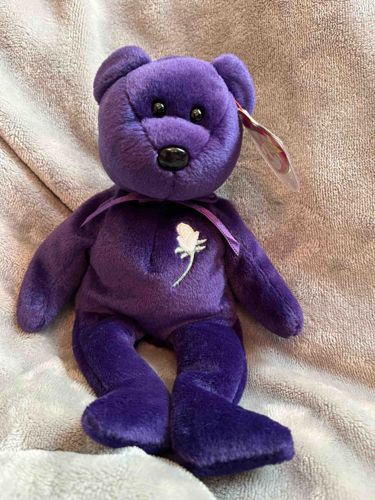
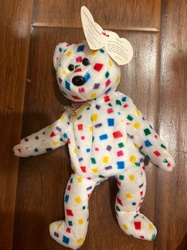
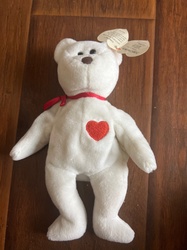
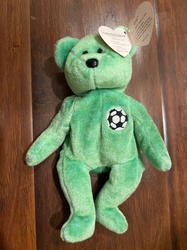
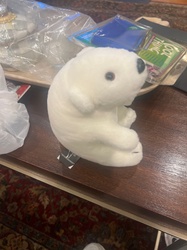
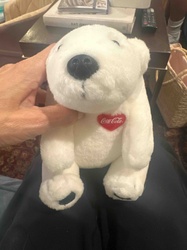
This item is a 'Princess' Beanie Baby, a plush teddy bear primarily made of a soft, deep purple polyester fiber, characteristic of the 'Ty Silk' fabric used in Beanie Babies. The bear features typical Beanie Baby construction with a bean-filled body, providing a floppy and poseable structure. It has small, black plastic bead eyes and a prominent black, triangular plastic nose. A thin, purple satin ribbon is tied in a bow around its neck. The most distinguishing feature is the embroidered white rose with a green stem and leaves on its chest, symbolizing the White Rose of England and commemorating Diana, Princess of Wales. A 'Ty' hang tag, which appears to be in good condition and still attached to the ear, is visible. The plush material shows minimal signs of wear; the purple color appears vibrant and unfaded. There are no visible tears, stains, or repairs. The stitching appears consistent and strong, indicating good craftsmanship for a mass-produced collectible toy. Based on its design and the specific details like the embroidered rose, this item belongs to the late 1990s era, specifically 1997-1999 when the 'Princess' Beanie Baby was produced. The overall condition appears excellent, suggesting it has been well-preserved.
AI Appraisal Report
I have thoroughly examined the provided image and information regarding this 'Princess' Beanie Baby. The plush teddy bear appears to be in excellent condition, showing a vibrant deep purple color, intact Ty Silk fabric, and no visible tears, stains, or repairs. The black bead eyes, triangular nose, and satin ribbon all appear original and well-preserved. Crucially, the embroidered white rose with a green stem and leaves, a definitive characteristic of the 'Princess' model, is clearly visible and well-defined. The presence of the 'Ty' hang tag, appearing in good condition and still attached, significantly enhances its perceived value. Based on the visual evidence, the item appears authentic for a 'Princess' Beanie Baby from the late 1990s production.
Regarding market conditions, the 'Princess' Beanie Baby holds a unique place due to its commemorative nature for Diana, Princess of Wales. While general Beanie Baby values have declined from their peak, certain rare variations or those in pristine condition with original tags, like this one, can still command modest collector interest. Factors like the specific generation of the swing tag and tush tag (e.g., P.V.C. pellets vs. P.E. pellets, Korean vs. Chinese production) can impact rarity and value. However, the market for 'Princess' Beanie Babies typically ranges from low double digits to a few hundred dollars, with very few reaching higher figures unless exceptionally rare variations (which cannot be determined from this image) are present.
My assessment of authenticity is based solely on visual cues from the image. For full and undeniable authentication, a physical examination would be necessary to verify the exact hang tag and tush tag generations and materials (e.g., P.V.C. vs. P.E. pellets), inspect stitching under magnification for inconsistencies, and potentially verify the fabric's tactile quality. Provenance documentation, such as original purchase receipts, would also add to authentication, though it's rare for these items. Scientific testing is generally not applied to Beanie Babies due to cost versus potential gain.