AI estimate as of November 8, 2025 · verify with a professional before acting
AI-Generated · Verify before acting
Everything on this page is generated by AI for informational purposes only. AI can make mistakes — the AI may misidentify items or misattribute them (artist, maker, brand, designer, origin, era). This is not an official valuation and should not be used for insurance, sale, tax, estate, legal, or lending purposes — or any decision requiring a certified appraisal. It is not an authoritative claim about any person, brand, or rights holder — do not share or rely on it as a factual statement about a third party. Always consult qualified professionals before making financial decisions.
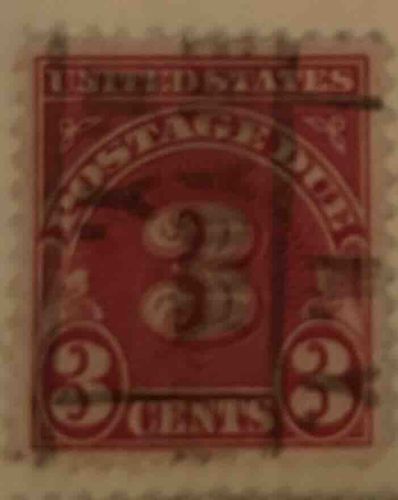
This item is a United States Postage Due stamp, specifically a 3-cent denomination, appearing in a reddish-brown or carmine shade. The stamp features a rectangular design with a serrated border, indicating it is likely perforated. The upper portion of the stamp prominently displays the words 'UNITED STATES' in capital letters, horizontally across the top. Below this, an arched banner reads 'POSTAGE DUE', also in capital letters. The central and dominant feature is a large, ornate numeral '3' with a swirling design within, indicating its value. In the lower left and right corners, there are smaller circular elements, each containing the numeral '3' again. Below the large central '3', the word 'CENTS' is printed horizontally. The overall design suggests a classic philatelic style, likely dating from the late 19th or early 20th century, consistent with the C.1894-1916 series of U.S. Postage Due issues. The stamp appears to be 'used' as evidenced by a visible cancellation mark in black ink across the upper left and central portions, partially obscuring 'UNITED STATES' and the 'POSTAGE DUE' banner. The color density seems consistent, although the image quality makes precise color determination challenging. The perforations appear relatively intact, though some wear or minor creasing might be present, particularly near the edges, which is common for used stamps of this age. There are no apparent major tears or repairs visible, but the cancellation mark affects a significant portion of the design. The craftsmanship reflects typical government-issued philatelic quality of the era. The paper type is difficult to ascertain from the image alone, but it would be standard stamp paper for the period.
AI Appraisal Report
This United States 3 Cents Postage Due stamp, likely from the C.1894-1916 series, presents as a used example. Visually, the stamp is perforated and bears a clear black cancellation mark, which obscures part of the "UNITED STATES" and "POSTAGE DUE" banners. The reddish-brown/carmine color appears consistent, though precise shade determination from an image is challenging. The perforations seem largely intact, which is positive for a stamp of this age. I observe no obvious major tears or repairs, however, minor creasing or wear along the edges, typical for used stamps, cannot be ruled out without physical inspection. The design and typography are consistent with authentic U.S. Postage Due issues of the era. Authenticity, based solely on visual inspection of the low-resolution image, appears good, but a definitive verification would require examination under magnification to check for watermarks, paper type, printing methods, and gum (if present for unused examples, though this is clearly used).
Market conditions for common U.S. Postage Due stamps of this denomination and era, especially in used condition, are generally stable but not exceptionally strong. This stamp falls into a category that is relatively common. While there's consistent collector interest in U.S. philately, single common used examples typically fetch modest prices. The cancellation mark, while authenticating its 'used' status, covers a significant portion of key design elements, which can slightly reduce aesthetic appeal and thus market value compared to a lightly cancelled example. Rarity is low for this specific issue and denomination in used condition. Therefore, the primary factor impacting value is its commonality and the extensive cancellation.
For a full authentication, I would require a physical examination to scrutinize paper characteristics, perforation type, potential hidden flaws, and to compare it to known genuine examples and expert certifications. Provenance, while not typically critical for such common stamps, would add certainty if available.