Photo and notes provided by the user — not generated by AI
Submitted photo · May 28, 2026
User's notes
No additional notes provided.
AI analysis below
AI appraisal
AI analysis & estimate
AI-Generated · Verify before acting
Everything below is generated by AI for informational purposes only. AI can make mistakes — the AI may misidentify items or misattribute them (artist, maker, brand, designer, origin, era). This is not an official valuation and should not be used for insurance, sale, tax, estate, legal, or lending purposes — or any decision requiring a certified appraisal. It is not an authoritative claim about any person, brand, or rights holder — do not share or rely on it as a factual statement about a third party. Always consult qualified professionals before making financial decisions.
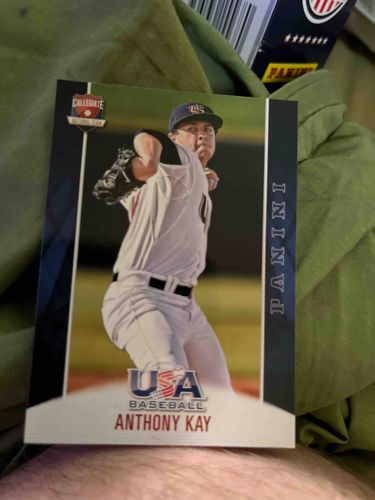
This item is a modern sports trading card, specifically a baseball card featuring player Anthony Kay. The card appears to be made of standard cardstock with a glossy finish. Its dimensions are consistent with typical trading cards, likely around 2.5 by 3.5 inches. The front of the card prominently displays a photograph of Anthony Kay in a pitching motion, wearing a white baseball uniform with a cap that has a 'USA' logo. The photo occupies the majority of the card's surface. Notable design elements include a dark blue vertical strip on the left side with a 'COLLEGIATE' shield logo at the top, and a similar dark blue vertical strip on the right side with the word 'PANINI' oriented vertically. Below the main image, the 'USA BASEBALL' logo is visible, followed by the player's name 'ANTHONY KAY' in a bold, red font. The overall color scheme is red, white, and blue, consistent with USA team branding. The card exhibits good condition with no apparent creases, tears, or significant surface abrasions visible in the image. The edges and corners appear sharp, suggesting a well-preserved state. There are no discernible smudges or fingerprints. The reverse side of the card is not visible but would typically contain player statistics, biographical information, and card series details. Based on the 'COLLEGIATE' and 'USA BASEBALL' branding, this card likely originates from a set produced by Panini America focused on collegiate or national team baseball prospects, likely in the mid to late 2010s to early 2020s, given Anthony Kay's playing career timeline.
AI Appraisal Report
·AI can make mistakes·Verify before acting
I have examined the provided image of the Anthony Kay Panini USA Baseball Collegiate Trading Card. Visually, the card presents in excellent condition. The surface appears pristine, free of scratches, creases, or smudges. Edges and corners are sharp, indicative of careful handling and storage. The colors are vibrant, and the print quality seems high. Authenticity, based solely on this image, appears good; the design elements, logos ('PANINI', 'USA BASEBALL', 'COLLEGIATE'), and player name font all align with typical Panini products of that era. However, it is crucial to note that full authenticity cannot be guaranteed without physical inspection. I would need to examine the card under magnification to verify print details, card stock, and security features, if any. Provenance documentation (e.g., original packaging, purchase receipts) would also strengthen authenticity.
In terms of market conditions, Anthony Kay is a pitcher who has had a modest MLB career, primarily as a relief pitcher. While he played for USA Baseball, he is not considered a superstar or Hall of Fame-caliber player, which significantly impacts card values. Collegiate cards often have lower demand than professional rookie cards. Comparables for similar non-rookie, non-superstar Panini collegiate baseball cards typically range from a few dollars to perhaps twenty dollars, depending on parallels or unique inserts. This appears to be a base card. Rarity is low as these are mass-produced base cards.
Key factors limiting the value are the player's career trajectory (not a star), the fact that it's a collegiate card (not an MLB rookie), and its status as a base card with no apparent rare parallels or autographs. Without in-person inspection and potential grading by a professional service (like PSA or BGS), the highest value cannot be realized. Even if graded a '10', the market for base cards of non-superstar collegiate players is very limited. Therefore, authentication from images is limited to visual consistency; full verification requires hands-on examination, and potentially, scientific analysis of materials or ink.