AI estimate as of November 1, 2025 · verify with a professional before acting
AI-Generated · Verify before acting
Everything on this page is generated by AI for informational purposes only. AI can make mistakes — the AI may misidentify items or misattribute them (artist, maker, brand, designer, origin, era). This is not an official valuation and should not be used for insurance, sale, tax, estate, legal, or lending purposes — or any decision requiring a certified appraisal. It is not an authoritative claim about any person, brand, or rights holder — do not share or rely on it as a factual statement about a third party. Always consult qualified professionals before making financial decisions.
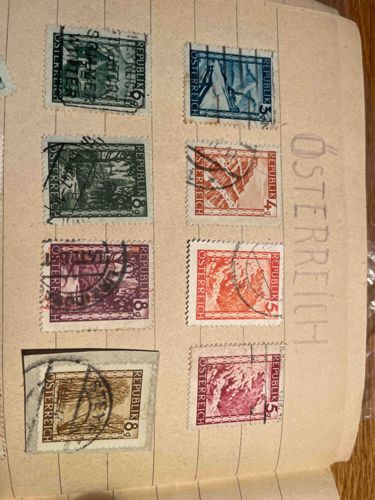
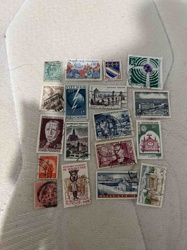
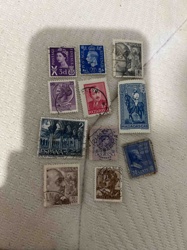
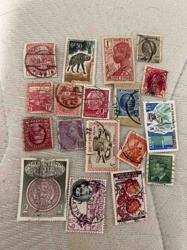
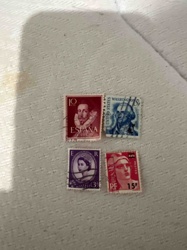
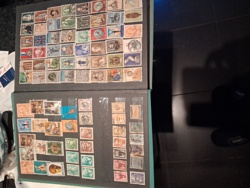
This item is a collection of several postage stamps from Austria, specifically from the 'Erste Republik' (First Republic) period, as indicated by the 'REPUBLIK ÖSTERREICH' inscription. The stamps are affixed to what appears to be a page from a stamp album, visible by the cream-colored paper background and the faint, hand-written or stamped 'ÖSTERREICH' label along the right edge. All visible stamps are rectangular with perforated edges, typical of classic postage stamps. They feature diverse designs, predominantly depicting Austrian landscapes or architectural elements. Colors vary, including shades of green (6 Groschen and 8 Groschen denominations), blue (3 Groschen), red-orange (4 Groschen and one 5 Groschen), purple (8 Groschen), and sepia/brown (another 8 Groschen). Denominations observed are 3, 4, 5, 6, and 8 Groschen, which were fractional units of the Austrian Schilling. Many of the stamps exhibit clear black postmarks, indicating they have been used. The postmarks obscure some of the design but confirm their postal history. The condition of the stamps varies; some appear well-preserved with clear designs and perforations, while others show more extensive cancellation marks. The sepia-toned 8 Groschen stamp, in particular, has a heavy, circular postmark that covers a significant portion of the image. The page itself shows some evidence of handling and minor discoloration consistent with age, suggesting the collection has been stored for a period. The stamps appear to be from the early to mid-20th century, likely the 1920s or 1930s, given the 'First Republic' attribution and visual style, which aligns with common Austrian stamp issues of that era. The craftsmanship is typical of national mints for postage stamps, focusing on clear engraving and printing for mass production. There are no obvious major tears or severe damage to the stamps themselves, though the heavy postmarks reduce their collector value compared to unused, unhinged examples.
AI Appraisal Report
I have visually examined the provided image of this collection of Austrian postage stamps from the First Republic era. The stamps, all bearing the 'REPUBLIK ÖSTERREICH' inscription, appear authentic to the period, with typical designs, denominations (3, 4, 5, 6, and 8 Groschen), and perforations consistent with issues from the 1920s-1930s. All visible stamps are used, as evidenced by clear black postmarks. The condition varies; while designs are discernible, many postmarks are heavy, particularly on the sepia 8 Groschen stamp, which impacts aesthetic appeal. No significant tears or damage are apparent from the image alone, just general wear associated with handled, canceled stamps on an album page.
Market conditions for common, used First Republic Austrian stamps are generally stable but modest. These are not considered rare issues. Comparables indicate that individual used stamps of this type typically fetch less than a dollar each, with some common sets or topics commanding slightly more. Demand for these specific issues is moderate among general European stamp collectors, but intense rarity or specialized demand is absent without unique cancellations or plate varieties, which cannot be determined from this image. The heavy cancellations significantly reduce collector value compared to unmounted mint or lightly canceled examples.
Limitations: My assessment of authenticity is based solely on visual characteristics; without physical examination, I cannot verify paper type, watermarks, gum condition (for unused examples, though these are used), or precise printing methods. Full authenticity verification would require in-person inspection to confirm perforation gauges, absence of repairs, and any potential forgeries. Provenance documentation could provide additional historical context, but for common used stamps, it's rarely available or impactful on value. Scientific testing is unnecessary for this category of stamps unless a specific rarity or error is suspected, which is not the case here.