These notes were written by the person who submitted this item. Appraiser.AI has not verified them, and the AI's identification and estimate may rely on them.
AI Estimated Value
Not an official valuation
$45-75
AI estimate as of August 12, 2025 · verify with a professional before acting
AI-Generated · Verify before acting
Everything on this page is generated by AI for informational purposes only. AI can make mistakes — the AI may misidentify items or misattribute them (artist, maker, brand, designer, origin, era). This is not an official valuation and should not be used for insurance, sale, tax, estate, legal, or lending purposes — or any decision requiring a certified appraisal. It is not an authoritative claim about any person, brand, or rights holder — do not share or rely on it as a factual statement about a third party. Always consult qualified professionals before making financial decisions.
This analysis also relies on unverified notes provided by the user, which may be incomplete or inaccurate and could affect the result.
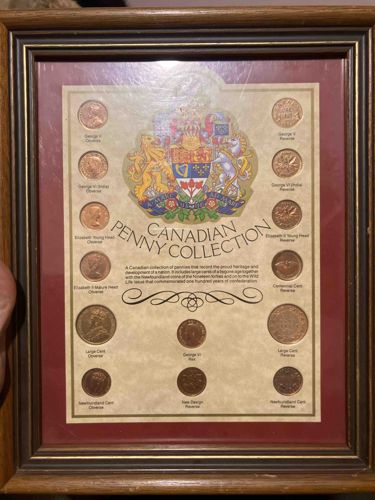
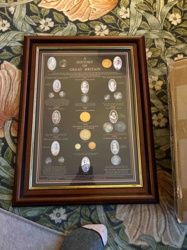
This item is a framed 'Canadian Penny Collection' display, designed to showcase various Canadian one-cent coins. The overall dimensions of the frame appear to be approximately 10-12 inches wide and 12-14 inches high, although specific measurements are not provided. The frame itself is constructed from wood with a natural, medium-brown stain, featuring a slightly distressed or aged appearance. There's a subtle inner black trim accenting the frame's opening, adding a touch of contrast and depth. The collection is presented on a mat board, which is primarily a light, parchment-like beige color, bordered by a darker, rich maroon or burgundy inner mat. This color scheme suggests a classic and somewhat formal presentation.
At the center top of the display is a prominent, colorful rendition of the Canadian Coat of Arms, serving as the focal point and underscoring the national theme of the collection. Below this, the title 'CANADIAN PENNY COLLECTION' is boldly printed. An explanatory text block is positioned below the title, stating, 'A Canadian collection of pennies that record the proud heritage and development of a nation. It includes large cents of a bygone age together with the Newfoundland coins of the nineteen forties and one life issue that commemorated one hundred years of confederation.'
Around the central text and crest, there are eighteen Canadian pennies, seemingly secured within cut-outs in the mat board, allowing both the obverse and reverse sides to be displayed for different denominations and periods. Each coin is accompanied by a small printed label identifying its specific type or ruler, such as 'George V Obverse', 'Elizabeth II Young Head Reverse', 'Large Cent Obverse', 'George VI Rex', 'Newfoundland Cent Obverse', 'Newfoundland Cent Reverse', 'Centennial Cent Reverse', etc. The coins exhibit varying degrees of toning and patina typical for copper/bronze coinage, indicating their age and circulation. Some appear to have darker, more even patinas, while others might show some brighter copper tones or minor surface blemishes consistent with their age and handling. There are no visible major damages to the frame or the coins from the image, though minor scuffs or dust on the glass (which appears reflective) are possible. The craftsmanship of the display, with its neat matting and clear labeling, suggests a commercially produced item, possibly from the mid to late 20th century, designed as a commemorative or educational set rather than a high-end numismatic rarity.
AI Appraisal Report
Upon examining the provided image of the 'Canadian Penny Collection' display, I assess its condition as good to very good. The wooden frame appears intact with no significant damage, exhibiting a natural, aged stain. The matting, with its light beige and maroon scheme, seems clean and the coins are neatly presented within their cut-outs. The labels are clear and legible. This is consistent with a commercially produced, commemorative item. Authenticity of the display itself is evident as a manufactured product, likely from the mid-to-late 20th century, designed for educational or decorative purposes rather than as a high-value numismatic presentation.
The coins themselves appear to be genuine Canadian pennies, exhibiting typical toning and patina for their age and circulation. Their individual condition ranges from circulated to possibly fine. Without physical inspection, I cannot assess specific details like mint marks, strike quality, or surface abrasions. Limitations in authenticity verification from images alone are significant; while the coins visually appear legitimate for their type, an in-person examination would be crucial to verify their specific varieties, confirm no alterations or environmental damage not visible in the image, and assess their precise numismatic grade, which directly impacts individual coin value. Provenance documentation could further confirm their history, though for a circulated collection like this, it's less critical for authenticity than for rarity.
Market conditions for such framed collections are generally modest. They appeal primarily to casual collectors of Canadiana, history enthusiasts, or those seeking decorative wall art. This is not a high-end numismatic offering. Comparables show similar framed sets (often from companies like 'The Franklin Mint' or generic coin dealers) typically selling in the low to mid-range. Demand is steady but not high, as the individual coin values are generally low-grade common dates. The rarity of the overall display is low; these were produced in fair numbers. The primary value drivers are the aesthetic presentation, the inclusion of a 'Large Cent' and 'Newfoundland Cents' (though likely common dates), and the commemorative nature. Factors that depress value include the circulated condition of the coins and the fact that most pennies, individually, have nominal value. The lack of rare dates or high-grade specimens limits its numismatic appeal significantly.
For full authentication and precise grading of the coins, a physical inspection by a numismatic expert is essential. This would allow for examination under magnification, weight and diameter verification, and identification of specific varieties. For the display unit itself, no further authentication is required beyond visual confirmation.