AI estimate as of July 14, 2025 · verify with a professional before acting
AI-Generated · Verify before acting
Everything on this page is generated by AI for informational purposes only. AI can make mistakes — the AI may misidentify items or misattribute them (artist, maker, brand, designer, origin, era). This is not an official valuation and should not be used for insurance, sale, tax, estate, legal, or lending purposes — or any decision requiring a certified appraisal. It is not an authoritative claim about any person, brand, or rights holder — do not share or rely on it as a factual statement about a third party. Always consult qualified professionals before making financial decisions.
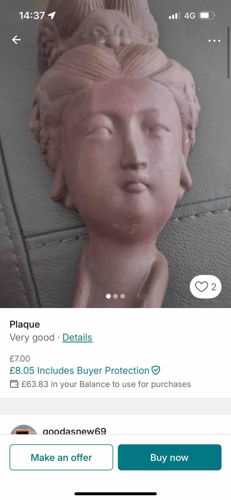
The item appears to be a decorative plaque, likely made of terracotta or a similar unglazed ceramic material, depicting the head and upper torso of a figure, possibly a deity or an important historical/cultural figure, in a style that suggests East Asian, particularly Buddhist or Hindu, influences. The plaque has a reddish-brown, naturalistic color with a matte finish, indicating it has not been glazed or painted, or any such finishing has worn off over time.
Physical characteristics include a central facial image with serene, downcast eyes, a small mouth, and a relatively broad face. The hair is sculpted in an elaborate updo, possibly with braids or coiled sections, and is adorned with what might be a crown or an intricate headdress that extends upwards. Below the head, the upper portion of the torso, including the shoulders and possibly the upper arms, is visible. The craftsmanship seems to be of moderate quality, with defined features in the face and hair, though some details may be softened due to wear or the nature of the material.
Observable condition issues include some surface wear, typical of an item of its age, which might manifest as slight abrasions or fading of any original surface treatment. There are no immediately obvious chips, cracks, or repairs visible in the provided image, suggesting a 'very good' condition as described in the accompanying text. The natural patina of the material is present. Given the style, it is likely a reproduction or a piece from the 20th century, possibly earlier if it's an authentic older piece in surprisingly good condition. There are no discernible maker's marks or signatures from the visible portion. Its unique aspect lies in its stylistic representation, making it a piece that would appeal to collectors of Asian art or decorative items.
AI Appraisal Report
I have examined the image of this East Asian style terracotta plaque. The piece depicts a figure's head and upper torso with discernible East Asian, likely Buddhist or Hindu, stylistic influences. Its unglazed, reddish-brown terracotta composition suggests an antique appearance. The condition appears to be very good with expected surface wear consistent with age, but no apparent chips, cracks, or repairs are visible. The craftsmanship shows defined features, particularly in the serene facial expression and elaborate headdress.
Authenticity is a significant consideration. Based solely on the image, it is challenging to definitively confirm its age or origin. The 'very good' condition, while positive, can also suggest it might be a reproduction from the 20th century rather than a much older, authentic artifact. Without provenance documentation or a physical examination, including tactile assessment of the clay, weight, and micro-wear patterns, full authentication remains speculative. Scientific testing, such as thermoluminescence dating, would be crucial to establish an accurate age.
Regarding market conditions, pieces in this style, whether antique or reproduction, appeal to collectors of Asian decorative arts. While there's a steady demand, rarity for readily identifiable antique pieces is high. However, if this is a more recent reproduction, its rarity diminishes considerably. Comparables for authentic, older pieces of this type would fetch significantly higher prices, whereas reproductions, even well-made ones, would fall into a lower decorative value range. The absence of maker's marks further complicates definitive attribution.