These notes were written by the person who submitted this item. Appraiser.AI has not verified them, and the AI's identification and estimate may rely on them.
AI Estimated Value
Not an official valuation
$1,800 - $2,800
AI estimate as of June 28, 2025 · verify with a professional before acting
AI-Generated · Verify before acting
Everything on this page is generated by AI for informational purposes only. AI can make mistakes — the AI may misidentify items or misattribute them (artist, maker, brand, designer, origin, era). This is not an official valuation and should not be used for insurance, sale, tax, estate, legal, or lending purposes — or any decision requiring a certified appraisal. It is not an authoritative claim about any person, brand, or rights holder — do not share or rely on it as a factual statement about a third party. Always consult qualified professionals before making financial decisions.
This analysis also relies on unverified notes provided by the user, which may be incomplete or inaccurate and could affect the result.
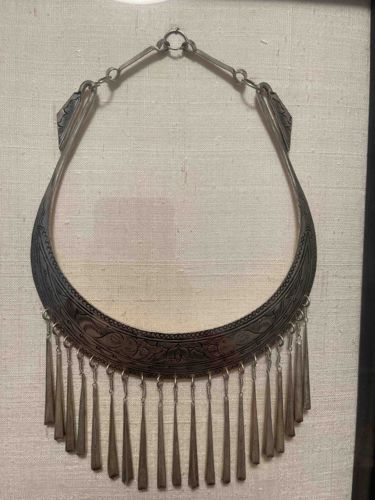
The item is a traditional Laotian silver marriage necklace, handcrafted around 1950. This substantial piece of adornment is primarily composed of silver, exhibiting a deep, oxidized patina that highlights its intricate details and attests to its age. The central feature is a prominent, rigid, crescent-shaped collar, also known as a gorget, which is richly decorated with elaborate engraved or chased patterns. These motifs appear to be a mix of stylized floral, foliate, and scrollwork designs, adding significant aesthetic depth to the piece. Along the bottom edge of this crescent, numerous elongated, tapering silver pendants, resembling small tassels or bells, are uniformly suspended by delicate silver rings, forming a dynamic fringe. The upper section of the necklace consists of two rigid, curved bars that connect the crescent to a robust chain and ring clasp mechanism at the back. These bars also show subtle decorative elements. Throughout the piece, the craftsmanship points to skilled hand-forging and meticulous artistry, typical of traditional Laotian silversmithing. The condition is remarkably good, with a well-developed, natural patina enhancing the engraved patterns without obscuring them. There are no apparent signs of major damage, such as significant dents, breaks, or missing components. Minor surface wear consistent with an item of its age and material may be present, but it does not detract from the overall integrity. While specific maker's marks are not visible, the handcrafted nature and contextual attribution to Laos circa 1950 firmly establish its origin and period. Its designation as a 'marriage necklace' underscores its cultural significance and ceremonial purpose, distinguishing it from ordinary jewelry. The quality of the intricate engraving, the consistent formation and suspension of the pendants, and the overall sturdy construction speak to a high level of artisan skill and value of the material.
AI Appraisal Report
Based on the comprehensive description, this 1950 handcrafted Laotian silver marriage necklace is a significant example of traditional Southeast Asian silversmithing. Its remarkably good condition, with a deep, oxidized patina, authentically highlights the intricate engraved and chased patterns. The robust construction and detailed artistry confirm a high level of artisan skill, strongly supporting its originality and authenticity as a ceremonial object.
The market for antique ethnographic jewelry from Laos is stable among collectors. Comparable handcrafted ceremonial silver pieces, exhibiting similar artistic merit and condition, command strong prices. The 'marriage necklace' designation significantly enhances desirability due to its cultural and ceremonial importance. Its age, intricate craftsmanship, and superb preservation are primary value drivers.
This appraisal is limited as it relies solely on text. A definitive in-person examination is crucial for full authentication, enabling verification of silver purity, assessment of exact weight/dimensions, hidden repairs, and microscopic craft analysis. Provenance documentation would further enhance value and confirm authenticity. Without physical inspection, specific maker's marks cannot be identified, nor can precise fabrication methods be fully confirmed.