AI estimate as of October 25, 2025 · verify with a professional before acting
AI-Generated · Verify before acting
Everything on this page is generated by AI for informational purposes only. AI can make mistakes — the AI may misidentify items or misattribute them (artist, maker, brand, designer, origin, era). This is not an official valuation and should not be used for insurance, sale, tax, estate, legal, or lending purposes — or any decision requiring a certified appraisal. It is not an authoritative claim about any person, brand, or rights holder — do not share or rely on it as a factual statement about a third party. Always consult qualified professionals before making financial decisions.
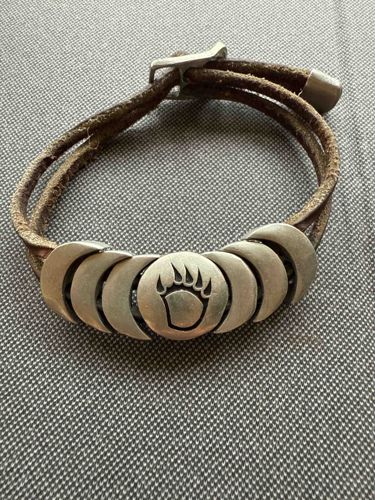
This item is a bracelet featuring a central metal charm with an embossed bear paw print, flanked by a series of four crescent-shaped metal links on each side, for a total of nine metal elements. The central bear paw charm is circular with a raised, darkened outline of a bear paw and claws against a lighter, brushed metal background. The crescent links gradually decrease in size towards the ends of the charm assembly. All metal components appear to be made of a non-precious white metal, possibly pewter or a silver-plated alloy, exhibiting a matte or brushed finish with some signs of surface wear and light scratching consistent with use. The metal elements are strung onto two parallel strands of what appears to be braided or rounded brown leather cord. The cord is a medium-brown color, showing significant signs of wear, fraying, and darkening in areas, suggesting it is well-used and, in some places, possibly dried and cracked. The bracelet is secured by a simple hook-and-eye style clasp, possibly also crafted from the same white metal as the charms, and an end cap that secures the cords on one side. The overall aesthetic suggests a rustic, possibly Southwestern or Native American-inspired design. The craftsmanship appears to be folk art or mass-produced, with no discernible maker's marks visible in the images. The aged appearance of the leather and metal suggests an estimated age of mid-to-late 20th century or early 21st century.
AI Appraisal Report
I have examined the image of this Bear Paw Charm Leather Cord Bracelet. The central motif is a metal charm with an embossed bear paw print, flanked by crescent-shaped metal links, all strung on a double strand of brown leather cord, secured by a hook-and-eye clasp.
Based on visual assessment, the condition is fair to good for its type. The metal components, likely a non-precious white metal like pewter or a silver-plated alloy, show signs of wear, light scratching, and a brushed or matte finish consistent with use. The leather cord exhibits significant wear, fraying, darkening, and appears somewhat dried or cracked in areas, indicating considerable age and use. The craftsmanship suggests either folk art or mass-produced origins, likely mid-to-late 20th century or early 21st century. I see no visible maker's marks.
From a market perspective, comparable items, often referred to as 'Southwestern style' or 'Native American-inspired' costume jewelry, typically have a limited market value. Factors significantly impacting value are the non-precious materials, the signs of wear, and the absence of any established artisan or brand. While the bear paw motif is popular, this specific execution does not suggest high-end craftsmanship or rare materials. Demand for this type of vintage costume jewelry is moderate, appealing to collectors of rustic or themed accessories, but not to fine jewelry enthusiasts.
Limitations in authenticity verification are significant. Without physical inspection, I cannot definitively confirm the metal composition (e.g., silver content vs. base metal), the exact age, or rule out it being a modern reproduction. An in-person examination would allow for closer inspection of metal patination, a tactile assessment of the leather's condition, and confirmation of material weight and composition. Provenance documentation could provide insight into its origin and maker, if any. Scientific testing (e.g., XRF analysis) would be required for definitive material identification. Given these factors, my appraisal reflects its current condition and material value as a vintage, non-precious costume jewelry item.