AI Appraisal Estimate

AI-generated estimates · not official valuations

From the user

What was submitted

Photo and notes provided by the user — not generated by AI

Submitted item photo
Submitted photo · June 10, 2026

User's notes

No additional notes provided.

AI analysis below

AI appraisal

AI analysis & estimate

AI-Generated · Verify before acting

Everything below is generated by AI for informational purposes only. AI can make mistakes — the AI may misidentify items or misattribute them (artist, maker, brand, designer, origin, era). This is not an official valuation and should not be used for insurance, sale, tax, estate, legal, or lending purposes — or any decision requiring a certified appraisal. It is not an authoritative claim about any person, brand, or rights holder — do not share or rely on it as a factual statement about a third party. Always consult qualified professionals before making financial decisions.

Read the full disclaimer

AI Identification

·Not independently authenticated·Verify before acting

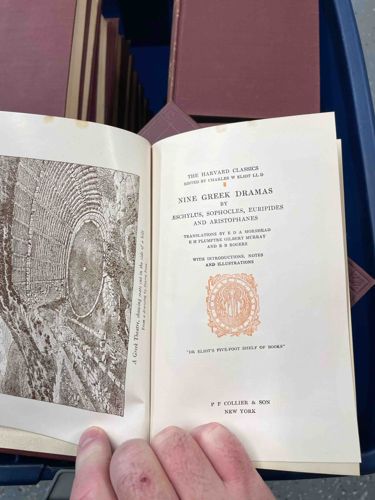
The Harvard Classics: Nine Greek Dramas (Volume 8)

Antique and Vintage Books

AI Estimated Value

·Not an official valuation·Verify before acting

$10 - $25

As of June 10, 2026

AI Item Analysis

·AI can make mistakes·Verify before acting
This is a single volume from the renowned 'Harvard Classics' collection, specifically Volume 8 containing 'Nine Greek Dramas' by Aeschylus, Sophocles, Euripides, and Aristophanes. The volume is part of the 'Five-Foot Shelf of Books' series edited by Charles W. Eliot and published by P.F. Collier & Son in New York. The book features a cloth-bound hardcover in a deep maroon or burgundy color with a textured finish. The title page showcases a distinctive orange or terracotta-colored colophon/seal and clean, professional typography characteristic of early-to-mid 20th-century mass-market classic editions. Facing the title page is a black-and-white gravure-style frontispiece illustration depicting an ancient Greek theater. Physically, the paper shows mild age-toning, consistent with its vintage nature, likely dating from the 1909 to 1930s production period. There are visible 'foxing' spots or small brown stains along the top edge of the frontispiece page, which indicates exposure to humidity over time. The binding appears structurally intact, though more volumes from the set are visible in the background, suggesting this is part of a larger collection. Such editions were designed for the Everyman and emphasize clarity and durability over luxury materials, utilizing machine-made paper and standard cloth bindings.
AI Appraisal Report

·AI can make mistakes·Verify before acting
I have examined the provided images of 'The Harvard Classics Volume 8: Nine Greek Dramas.' This volume is a standard trade edition published by P.F. Collier & Son, part of the 'Five-Foot Shelf' series. Based on the typography and the terracotta colophon, this specimen appears to be an authentic printing from the early 1930s. The deep burgundy cloth binding shows typical shelf wear, and the internal pages exhibit moderate foxing—particularly on the frontispiece—and age-toning consistent with the acidic paper stock used for mass-market distribution in that era. From a market perspective, the Harvard Classics were printed in massive quantities, with hundreds of thousands of sets produced to fulfill Charles W. Eliot’s vision of a 'portable library.' Consequently, individual volumes are not rare. The primary market demand exists for complete 50 or 51-volume sets in fine condition. Broken sets or single volumes like this one typically serves as 'reader copies' or replacements for existing sets. The value is significantly suppressed by the high volume of extant copies and the presence of foxing, which collectors often view as a deterrent. Similar volumes currently trade frequently in the $10 to $25 range on secondary markets like eBay or AbeBooks. Limitations: This appraisal is based strictly on visual digital evidence. A physical inspection would be required to verify the integrity of the hinge, check for missing pages, or identify 'red rot' in the binding. Authentication of the specific printing year would require examining the copyright page and verifying the publisher's address. No scientific testing was performed; however, the book's mass-produced nature makes the risk of forgery negligible. Full authentication would rely on verifying the complete provenance of the set from which this volume originated.

Get your items appraised

Instant estimates of your treasures with AI-powered appraisals

Browse More Appraisals