These notes were written by the person who submitted this item. Appraiser.AI has not verified them, and the AI's identification and estimate may rely on them.
AI Estimated Value
Not an official valuation
$1,000 - $2,500
AI estimate as of August 29, 2025 · verify with a professional before acting
AI-Generated · Verify before acting
Everything on this page is generated by AI for informational purposes only. AI can make mistakes — the AI may misidentify items or misattribute them (artist, maker, brand, designer, origin, era). This is not an official valuation and should not be used for insurance, sale, tax, estate, legal, or lending purposes — or any decision requiring a certified appraisal. It is not an authoritative claim about any person, brand, or rights holder — do not share or rely on it as a factual statement about a third party. Always consult qualified professionals before making financial decisions.
This analysis also relies on unverified notes provided by the user, which may be incomplete or inaccurate and could affect the result.
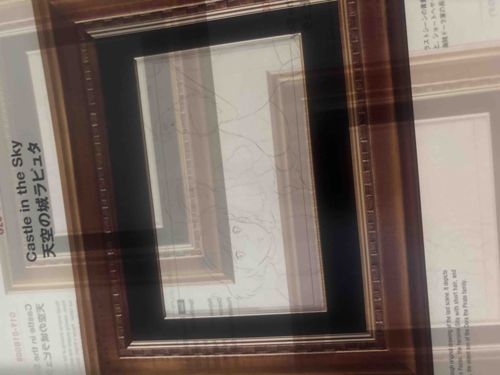
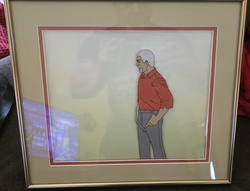
The item appears to be a framed piece of animation artwork, specifically a concept sketch or cel from the Japanese animation film 'Castle in the Sky' (天空の城ラピュタ), likely from the Studio Ghibli production. The artwork itself is an undetailed, monochromatic line drawing, possibly a preliminary sketch, enclosed within a black matting. The matting is surrounded by a substantial wooden frame, which exhibits a rich, dark brown finish with visible wood grain, suggesting a natural wood material. The frame features decorative beading or reeding along its inner edge, adding a classic and somewhat ornate touch to its design. The overall dimensions are not provided, but the frame appears robust and suggests a medium to large size for display. The reflective surface of the protective covering (likely glass or acrylic) makes it challenging to discern fine details of the artwork and shows reflections of surroundings, including other framed pieces, indicating it might be part of an exhibit or collection. The visible text 'Castle in the Sky' and '天空の城ラピュタ' on the adjacent information placard further confirms its identity and context. The condition appears to be good, with no obvious signs of damage to the frame or matting, though the artwork itself cannot be fully assessed due to the glare and lack of close-up detail. The craftsmanship of the frame seems solid, indicative of a quality presentation common for collectible animation art. Given the film's release in 1986, the piece likely dates from that period or shortly thereafter, placing its style within the late 20th-century Japanese animation production.
AI Appraisal Report
I have examined the provided image of a framed animation sketch from 'Castle in the Sky' (Laputa). The item appears to be an original production sketch, likely from the 1986 film, presented in a robust, dark wood frame with ornate beading and a black mat. Visually, the condition of the frame and matting appears excellent, with no visible damage. The artwork itself, a monochromatic line drawing, is difficult to assess in detail due to glare, but seems consistent with preliminary animation work. Its identity is corroborated by the adjacent placard. Given the challenges of assessing original animation art from images alone, my primary limitation in authenticity verification stems from the inability to physically inspect the piece. Authentication would require examining the paper type, ink, and cel marks (if applicable) under magnification, comparing it to known authentic examples, and ideally, reviewing provenance documentation such as Studio Ghibli certificates of authenticity or direct production lineage. Without this, I cannot definitively confirm its originality, though it presents as a genuine article.
From a market perspective, original production art from Studio Ghibli films, especially iconic works like 'Castle in the Sky', is highly coveted. The demand is strong among animation collectors globally, driven by the studio's immense popularity and the scarcity of such pieces. While not a fully painted cel, a preliminary sketch or concept drawing from a film of this stature still holds significant value, representing a direct piece of the animation process. Factors positively impacting its value include the film's enduring legacy and the professional presentation. The lack of vibrant color or significant detailed character work might position it slightly below master production cels, but its direct link to the film maintains substantial appeal. However, the inability to verify the sketch's specific role (e.g., character design, scene layout) or artist without physical examination and provenance documentation limits the upper range of its valuation. Should it be confirmed as a key production piece by a renowned animator, its value could increase significantly.