These notes were written by the person who submitted this item. Appraiser.AI has not verified them, and the AI's identification and estimate may rely on them.
AI Estimated Value
Not an official valuation
$50 - $150
AI estimate as of August 17, 2025 · verify with a professional before acting
AI-Generated · Verify before acting
Everything on this page is generated by AI for informational purposes only. AI can make mistakes — the AI may misidentify items or misattribute them (artist, maker, brand, designer, origin, era). This is not an official valuation and should not be used for insurance, sale, tax, estate, legal, or lending purposes — or any decision requiring a certified appraisal. It is not an authoritative claim about any person, brand, or rights holder — do not share or rely on it as a factual statement about a third party. Always consult qualified professionals before making financial decisions.
This analysis also relies on unverified notes provided by the user, which may be incomplete or inaccurate and could affect the result.
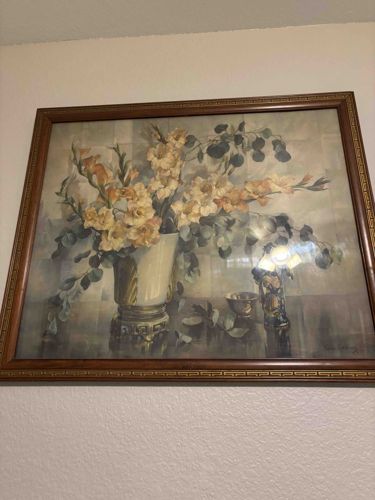
The item is a framed floral still-life print or lithograph, likely a reproduction of a painting by Cecil Golding, given the provided context. The artwork depicts a vibrant arrangement of light-colored flowers, primarily gladioli and possibly other similar blooms, in shades of cream, pale yellow, and soft orange, set within a tall, elegant, cream-colored vase. The vase appears to be made of a ceramic or metallic material, featuring ornate, possibly gilded, detailing around its base. Foliage, rendered in muted greens and blues, cascades gracefully from the vase, adding depth and shadow to the composition. The background is subtle, suggesting an interior setting with hints of light and shadow. On the table surface beside the main vase, there are indications of other objects, possibly a smaller decorative bowl or vessel, and another taller, more slender container with darker patterns, reflecting light. The overall color palette is subdued yet warm, with a focus on light and atmosphere. The print is housed in a substantial wooden frame with a rich, reddish-brown stain and visible wood grain. The frame features an inner decorative band with a repeating geometric pattern, possibly a Greek key motif, adding a touch of classical elegance. The image quality, particularly the reflections, suggests the presence of glass protecting the print. No overt damage like tears or severe discoloration is visible on the print itself, though minor surface wear or dust on the glass is possible. The frame appears to be in good condition with a slight patina consistent with age. This piece likely dates from the mid to late 20th century, common for decorative framed prints used in home decor.
AI Appraisal Report
Upon examining the provided image of the framed floral still-life print attributed to Cecil Golding, my assessment is as follows:
**Condition and Authenticity:** The print appears to be in very good condition. The colors are vibrant, and there are no discernible tears, major creases, or significant discoloration. The frame, a substantial wooden piece with a reddish-brown stain and decorative inner band, also seems well-maintained, exhibiting a patina consistent with age. This piece is almost certainly a decorative print or lithograph, not an original painting by Cecil Golding. "Cecil Golding" is a known decorative artist/pseudonym often associated with mass-produced floral prints from the mid to late 20th century. My visual examination is limited to the image provided; without physical inspection, I cannot confirm the exact printing method (e.g., offset lithography, serigraph) or rule out subtle surface imperfections, foxing, or fading that might not be captured in the photograph.
**Market Conditions and Comparables:** Decorative floral prints from the mid-20th century, particularly those under mass-market pseudonyms like 'Cecil Golding,' typically fall into a modest price range. The market for such items is generally stable but not highly speculative. Comparables would include similar framed prints of decorative still lifes or landscapes from the same era, often found in estate sales, online marketplaces, or second-hand furniture stores.
**Demand and Rarity:** These prints are not rare. They were widely produced for home decor, satisfying a general demand for aesthetically pleasing wall art. While individual designs can be popular, the overall category is not characterized by rarity, which inherently limits high demand from collectors.
**Factors Impacting Value:** The primary value is decorative. The good condition of both the print and the frame is a positive factor. The size, while not specified, appears substantial, which can add to its perceived decorative value. However, the lack of artist prestige (as it's a decorative artist/pseudonym rather than a fine artist with a strong auction record), the mass-produced nature, and its commonality significantly cap its monetary value.
**Limitations in Authenticity Verification:** Verifying "authenticity" for a decorative print is less about confirming the hand of a fine artist and more about confirming it's a legitimate print from the period by the attributed 'artist' or studio. An in-person examination would allow me to check the paper quality, printing technique, and any edition numbers or publisher marks which are typically absent on such decorative items. Provenance documentation (e.g., original sales receipts) would be helpful but rarely exists for such pieces. Scientific testing is not warranted for items of this nature.