AI estimate as of August 23, 2025 · verify with a professional before acting
AI-Generated · Verify before acting
Everything on this page is generated by AI for informational purposes only. AI can make mistakes — the AI may misidentify items or misattribute them (artist, maker, brand, designer, origin, era). This is not an official valuation and should not be used for insurance, sale, tax, estate, legal, or lending purposes — or any decision requiring a certified appraisal. It is not an authoritative claim about any person, brand, or rights holder — do not share or rely on it as a factual statement about a third party. Always consult qualified professionals before making financial decisions.
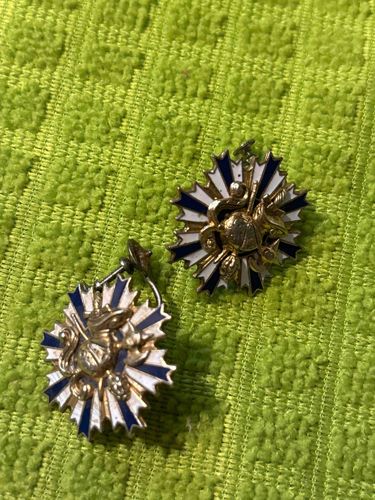
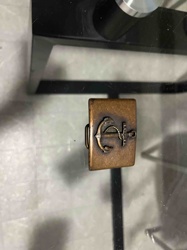
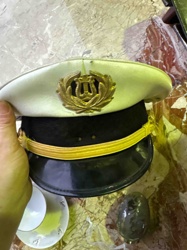
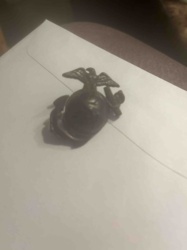
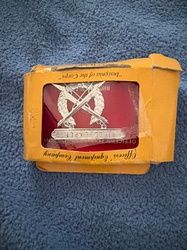
This item consists of a pair of identical, small, decorative insignia, likely lapel pins or earrings given their design and visible attachments. Each piece is circular or star-shaped, approximately 1 to 1.5 inches in diameter, and appears to be constructed from a gold-toned metal, possibly brass or gilt. The central design of each insignia features what looks like a stylized military or heraldic motif, with a helmeted figure, possibly a knight or a Roman soldier, flanked by what could be weapons or branches. This central motif is raised and three-dimensional, exhibiting fine detailing. Surrounding this central element is a sunburst or starburst pattern, characterized by alternating segments of white and dark blue enamel. The white segments are pointed and slightly wider, while the blue segments are narrower and fill the spaces between the white points. The enamel appears to be in good condition with minor signs of wear consistent with age, such as slight tarnishing or minor scratching on the metal surfaces, but no significant chips or cracks are discernable in the enamel. One of the pieces clearly shows an attachment loop, suggesting it could be a pendant, charm, or part of an earring. The other piece, while similar, shows a thinner, possibly broken or bent attachment, or it might be designed as a pin with a missing backing. The craftsmanship appears to be of good quality, with clear definition in the metalwork and crisp separation between the enameled sections. The style suggests a military decoration or a fraternal organization's emblem, dating possibly from the early to mid-20th century. While no specific maker's marks are visible from the provided image, the detailed central figure and multi-part construction indicate a manufactured item rather than a handmade one.
AI Appraisal Report
Based on my visual examination of the provided image, this pair of enamel and gilt military-style insignia appears to be in good overall condition. The enamel shows minor wear consistent with age but no significant chips or cracks. The gold-toned metal exhibits slight tarnishing and minor scratching, which is expected for items of this presumed vintage. The raised detailing of the central helmeted figure and the crisp enamel separation suggest good craftsmanship.
Authenticity: From the image alone, I assess these as likely authentic examples of manufactured insignia from the early to mid-20th century, possibly for a military unit, fraternal organization, or civic group. However, definitive authentication is limited without physical inspection. I cannot verify the metal composition (e.g., actual gold content vs. gilt) or the method of enamel application. Market conditions for such items vary widely. Generic, well-preserved fraternal or military insignia typically generate modest interest. Comparables would include similar era pins, badges, or charms from organizations like the Masons, Oddfellows, or military service branches. Demand for these specific insignia would depend heavily on their historical significance or association with a known, desirable organization, none of which can be determined from the image. Rarity is also difficult to ascertain; while unique designs are generally rarer, mass-produced items like these are often found in larger quantities.
Factors significantly impacting value include the precise origin (e.g., a rare military unit vs. a defunct local lodge), the materials used (e.g., solid gold and true enamel vs. brass and resin), and the intactness of both pieces with their original attachments. The differing attachment states on each piece (one seemingly complete loop, the other possibly broken or a pin) slightly reduces the pairing's appeal and value as a congruent set.
For full authentication, a physical examination would be crucial to determine metal composition, specific enamel type, and manufacturing techniques. Provenance documentation (e.g., original owner, historical context) would significantly enhance value, and specialized testing like XRF could confirm elemental composition. Without these, the appraisal is based solely on aesthetic condition and general market trends for similar decorative insignia.