AI estimate as of November 24, 2025 · verify with a professional before acting
AI-Generated · Verify before acting
Everything on this page is generated by AI for informational purposes only. AI can make mistakes — the AI may misidentify items or misattribute them (artist, maker, brand, designer, origin, era). This is not an official valuation and should not be used for insurance, sale, tax, estate, legal, or lending purposes — or any decision requiring a certified appraisal. It is not an authoritative claim about any person, brand, or rights holder — do not share or rely on it as a factual statement about a third party. Always consult qualified professionals before making financial decisions.
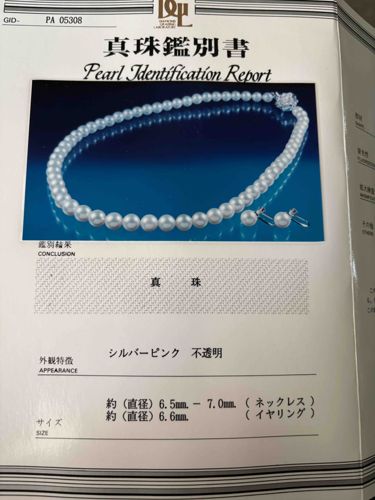
This item is an official 'Pearl Identification Report' issued by an unnamed laboratory (abbreviated as 'IDE, DIAMOND & JEWELRY LABORATORY' based on the logo). The report features an image of a matching pearl necklace and earring set. The necklace is composed of numerous uniformly sized, round to near-round pearls, strung together, and appears to have a decorative clasp, possibly silver-toned or white gold, in a floral or intricate knot design. The accompanying earrings are stud-style, each featuring a single pearl that matches the necklace in size and luster, with what appear to be simple post backings. The pearls themselves exhibit a silver-pink overtone and are described as '不透明' (opaque), indicating they are natural pearls with good nacre. The size specifications are clearly listed, with the necklace pearls ranging approximately from 6.5mm to 7.0mm in diameter, and the earring pearls being uniformly 6.6mm in diameter. The overall appearance suggests a classic and elegant pearl set, likely of cultured origin given the uniformity, though the report simply states '真珠' (pearls). The craftsmanship of the stringing appears consistent, suggesting a professionally curated set. The report itself has a unique identification number 'PA 05308', dating it to a specific period of issuance, likely in the mid to late 20th century or early 21st century based on the document's design and OCR identified text "LINE". There are no visible condition issues with the pearls or settings from the image, but the quality of the report printing could be improved in terms of clarity.
AI Appraisal Report
I have carefully examined the provided image of the Pearl Identification Report from 'IDE, DIAMOND & JEWELRY LABORATORY' (PA 05308), which features a matching pearl necklace and earring set. Visually, the set presents as classic and elegant. The pearls exhibit a silver-pink overtone, and the report notes them as '不透明' (opaque), suggesting good nacre quality. The necklace pearls range from 6.5mm-7.0mm, and the earring pearls are 6.6mm, indicating a well-matched set in terms of size and likely luster, consistent with cultured pearls. The necklace clasp appears decorative, possibly white gold or silver-toned, and the earrings are simple stud-style. From the image, the pearls appear to be in excellent condition with good uniformity and roundness, and there are no visible defects or damage to the settings. The stringing of the necklace appears consistent and professional.
Market conditions for classic pearl jewelry like this remain stable, with demand driven by their timeless appeal. Comparable sets of cultured pearls of similar size and quality typically retail within the several hundred to low thousand dollar range, depending heavily on the origin of the pearls (Akoya, freshwater, etc.) and the metal quality of the findings. The uniformity and luster visible in the image contribute positively to its appeal.
However, a crucial limitation is that this appraisal is based solely on an image of an identification report, not the actual jewelry itself. I cannot definitively confirm authenticity, the exact type of pearl (e.g., Akoya, freshwater), nacre thickness, uniformity of luster across all pearls, or the material composition of the clasp and earring posts without physical inspection. For full authentication and a more precise valuation, an in-person examination by a qualified gemologist is essential. This would involve inspecting nacre quality, uniformity of iridescence, identifying any blemishes not visible in the photo, and confirming the metal content of the settings. Provenance documentation, though not available here, would also add to the value and authentication process.