These notes were written by the person who submitted this item. Appraiser.AI has not verified them, and the AI's identification and estimate may rely on them.
AI Estimated Value
Not an official valuation
$30-75
AI estimate as of June 26, 2025 · verify with a professional before acting
AI-Generated · Verify before acting
Everything on this page is generated by AI for informational purposes only. AI can make mistakes — the AI may misidentify items or misattribute them (artist, maker, brand, designer, origin, era). This is not an official valuation and should not be used for insurance, sale, tax, estate, legal, or lending purposes — or any decision requiring a certified appraisal. It is not an authoritative claim about any person, brand, or rights holder — do not share or rely on it as a factual statement about a third party. Always consult qualified professionals before making financial decisions.
This analysis also relies on unverified notes provided by the user, which may be incomplete or inaccurate and could affect the result.
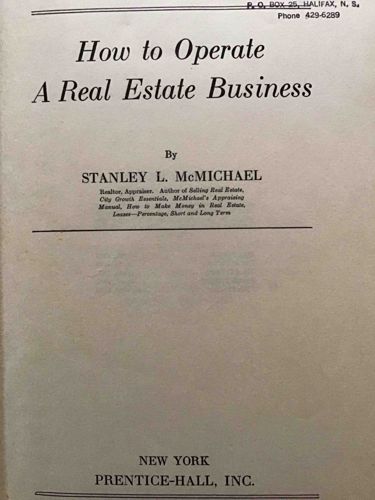
This item is identified as the title page or front cover of a vintage non-fiction book titled "How to Operate A Real Estate Business" by Stanley L. McMichael. The visible surface is a light, aged, off-white or cream-colored paper exhibiting a uniform subtle yellowing patina characteristic of older publications. All text is printed clearly in black ink using a classic serif typeface, suggesting a publication style dating to the mid-20th century or possibly earlier, which aligns with the historical period of the author's prominence. Key identifying features include the prominent centered title, the author's full name, and a detailed listing of his professional credentials and other works, such as "Selling Real Estate" and "McMichael's Appraising Manual." The publisher, "Prentice-Hall, Inc." of New York, is clearly displayed at the bottom. A notable and unique distinguishing element is the printed or stamped address and phone number "P.O. BOX 25, HALIFAX, N. S. Phone 429-6289" in the upper right corner, potentially indicating a previous owner's inscription, a regional bookstore, or a library mark. The item is in good condition, showing typical age-related discoloration but no significant visible damage like tears, major stains, or creasing on the surface depicted. The print quality is consistent and clear, demonstrating sound craftsmanship for a publication of its era.
AI Appraisal Report
Having examined the provided image and descriptive details, I can offer the following appraisal. The item, a vintage non-fiction book titled "How to Operate A Real Estate Business" by Stanley L. McMichael, appears to be in good overall condition for its age. The uniform subtle yellowing and clear print are consistent with an older publication, likely dating to the mid-20th century. There are no apparent tears, creases, or significant stains visible on the depicted surface, suggesting careful handling over time. The presence of the publisher "Prentice-Hall, Inc." confirms its authenticity as a standard publication.
While authenticity of a printed book is generally clear, the unique stamped address and phone number ("P.O. BOX 25, HALIFAX, N. S. Phone 429-6289") in the upper right corner is a notable feature. Without further provenance, this stamp can be seen as either a historical mark of a previous owner or bookshop, or a minor detraction for collectors seeking a pristine, unblemished copy.
The market for vintage real estate business texts like this one is niche but consistent. Books by prominent authors in their respective fields, such as McMichael, appeal to historians of business, real estate professionals, and collectors of specialized non-fiction. Comparable sales of similar well-preserved mid-century business or investment guides typically range from $20 to $80, depending on the author, specific title, and edition.
This particular title is not exceedingly rare, but copies in good condition, as described, are less common. Demand is driven more by academic or professional interest in historical real estate practices than broad collector appeal. Factors positively impacting value include its good condition and the author’s recognized stature in real estate literature. The stamped address, while unique, does not inherently add significant monetary value unless linked to a verifiable, notable provenance.
It is crucial to state that this appraisal is based solely on the provided image and description. A definitive assessment requires physical examination to verify the integrity of the binding, internal condition (e.g., foxing, internal markings, presence of inscriptions), and crucially, to confirm if it is a first edition or a later printing. Provenance research for the stamped address would also be beneficial for full authentication and value determination.