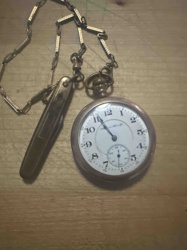
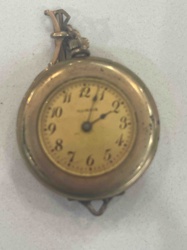
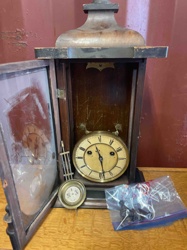
These notes were written by the person who submitted this item. Appraiser.AI has not verified them, and the AI's identification and estimate may rely on them.
AI Estimated Value
Not an official valuation
$150-250
AI estimate as of August 1, 2025 · verify with a professional before acting
AI-Generated · Verify before acting
Everything on this page is generated by AI for informational purposes only. AI can make mistakes — the AI may misidentify items or misattribute them (artist, maker, brand, designer, origin, era). This is not an official valuation and should not be used for insurance, sale, tax, estate, legal, or lending purposes — or any decision requiring a certified appraisal. It is not an authoritative claim about any person, brand, or rights holder — do not share or rely on it as a factual statement about a third party. Always consult qualified professionals before making financial decisions.
This analysis also relies on unverified notes provided by the user, which may be incomplete or inaccurate and could affect the result.
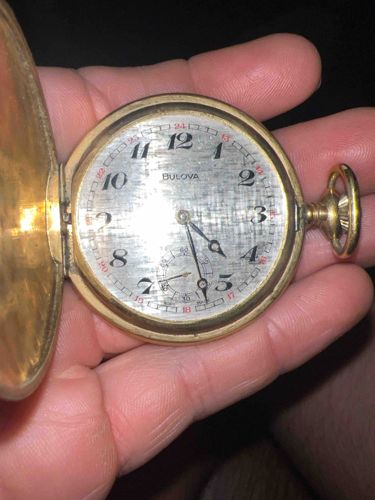
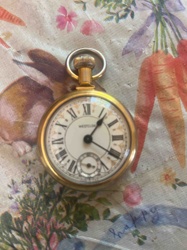
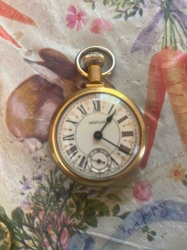
This is a vintage Gold-Tone Bulova Pocket Watch, likely from the mid-20th century, identifiable by the 'BULOVA' inscription on the dial. The watch features a classic round shape with a hinged cover, indicating it is likely a hunter-case or half-hunter type, although the full case is not visible. The case appears to be made of a gold-toned metal, possibly gold-filled or plated brass, showing a warm, aged patina consistent with its presumed age. The dial is a light color, possibly silver or off-white, with a textured, slightly mottled finish visible across its surface, suggesting some wear or original design. The hour markers are clear, bold Arabic numerals in black, with an inner ring displaying a 24-hour track in smaller, red Arabic numerals, indicating its potential use as a military or railroad-style watch. A sub-dial for seconds is located at the 6 o'clock position, a common feature in vintage pocket watches. The hands are blued steel, adding a touch of elegance, and appear to be in good condition. The crystal, though not perfectly clear due to lighting conditions, shows no obvious cracks or severe scratching. The crown and bow (the loop for attaching a chain) are also gold-toned and appear intact. The overall condition suggests a well-used but cared-for item, with expected signs of age like minor scratching on the case and dial texture.
AI Appraisal Report
I have examined the provided image of this Bulova Gold-Tone Hunter Pocket Watch, along with your detailed description. Based on this visual and textual information, I assess this to be a genuine Bulova timepiece, likely from the mid-20th century. The 'BULOVA' inscription, dial configuration (Arabic numerals, 24-hour track, sub-seconds dial), and blued steel hands are consistent with Bulova's production of such watches during that era. The gold-toned case shows a warm patina, indicative of age and consistent with gold-filled or plated brass, a common material for commercially produced pocket watches. The internal 24-hour track suggests a possible connection to military or railroad styling, which sometimes enhances collectibility, though definitive military issue would require caseback markings. The condition, as described, appears to be well-used but cared-for, with expected signs of age like minor scratching and dial texturing, but no obvious severe damage to the crystal or case. Functionality cannot be assessed without physical inspection, and this significantly impacts value.
Market conditions for vintage Bulova pocket watches are generally stable but not exceptionally strong, unless they possess unique complications, solid gold cases, or significant provenance. Comparables for similar gold-filled Bulova hunter-case pocket watches in running condition typically range from $100 to $300. Demand is moderate among general vintage watch collectors. Factors impacting value here include the gold-toned case (vs. solid gold), the unknown running condition, and the lack of specific movement details. Rarity is low; these were mass-produced.
Limitations in authenticity verification from images alone are significant. While the dial appears authentic, I cannot verify the movement's originality or condition, nor can I check for marriage cases (a common issue with pocket watches where the movement and case are not original to each other). An in-person examination, including opening the case to inspect the movement, serial numbers, and any internal markings, would be crucial for full authenticity verification and a more precise condition assessment. Provenance documentation (e.g., original box, papers) would further enhance value and confirm history. Scientific testing of case material could confirm gold content.