AI estimate as of August 22, 2025 · verify with a professional before acting
AI-Generated · Verify before acting
Everything on this page is generated by AI for informational purposes only. AI can make mistakes — the AI may misidentify items or misattribute them (artist, maker, brand, designer, origin, era). This is not an official valuation and should not be used for insurance, sale, tax, estate, legal, or lending purposes — or any decision requiring a certified appraisal. It is not an authoritative claim about any person, brand, or rights holder — do not share or rely on it as a factual statement about a third party. Always consult qualified professionals before making financial decisions.
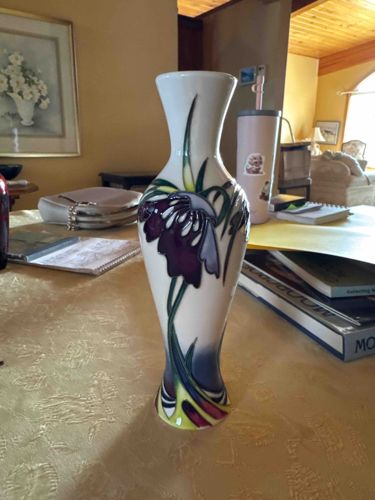
This is a ceramic vase, likely made of earthenware or stoneware, featuring a vibrant, hand-painted floral design. The vase stands tall with a flared rim, a gently tapering body, and a wider, stable base. Its primary color is an off-white or cream, providing a neutral canvas for the bold Art Deco-inspired decoration. The central motif is a large, stylized flower, possibly an iris or daylily, rendered in shades of deep plum or purple, highlighted with lighter lilac or grey accents. The flower is surrounded by elongated, flowing leaves and stems, painted in various greens, from dark forest green to lighter chartreuse. The design extends from the mid-body downwards, with the base exhibiting abstract, curvilinear splashes of lime green, deep purple, and a prominent streak of crimson or deep red, suggesting roots or stylized design elements. The painting style indicates a transfer print with hand-painted embellishments or entirely hand-painted details, revealing brushstrokes and variations in opacity. The glaze appears glossy, uniformly covering the surface. No visible chips, cracks, or significant damage are apparent from the provided image, suggesting good overall condition. Patina appears consistent with its age and material, with no overt signs of repair. While specific maker's marks are not visible, the design aesthetic strongly suggests it could be an item from the Art Deco period (1920s-1930s) or a later revival piece, possibly from the mid-20th century, particularly given its elegant form and bold, decorative patterning typical of this era's decorative arts. The craftsmanship appears to be of good quality, with clear lines and rich color application.
AI Appraisal Report
Upon my virtual examination of this Art Deco Style Hand-Painted Ceramic Vase, I find it to be in remarkably good condition, showing no visible chips, cracks, or significant surface abrasions. The glossy glaze appears largely intact, and the colors remain vibrant, suggesting careful handling over its lifespan. The design elements, including the bold floral motif and curvilinear patterns, are highly consistent with the Art Deco aesthetic of the 1920s-1930s, though it could also be a well-executed later revival piece. Authenticity based solely on images is challenging; while the style aligns, a physical inspection would be crucial to confirm the presence of authentic aging, craquelure patterns, and precise manufacturing techniques indicative of the period. Market conditions for decorative arts from the Art Deco period remain strong, especially for pieces with distinctive hand-painted elements and elegant forms. Comparable sales for vases of similar quality and aesthetic range widely, but well-preserved, true Art Deco pieces can fetch premium prices. Demand is consistent for quality period pieces, and while not exceedingly rare, a vase of this apparent condition and artistic merit is certainly desirable. Factors significantly impacting value include its age (true Art Deco vs. revival), the specific maker (if identifiable), and confirming the hand-painted nature through close examination. Without visible maker's marks or provenance, these details are currently speculative. To definitively authenticate and maximize value, an in-person examination is essential to assess patina, true brushwork, paste composition, and to search for obscured marks. Scientific testing for material dating, if necessary, would also require physical access.