AI estimate as of July 22, 2025 · verify with a professional before acting
AI-Generated · Verify before acting
Everything on this page is generated by AI for informational purposes only. AI can make mistakes — the AI may misidentify items or misattribute them (artist, maker, brand, designer, origin, era). This is not an official valuation and should not be used for insurance, sale, tax, estate, legal, or lending purposes — or any decision requiring a certified appraisal. It is not an authoritative claim about any person, brand, or rights holder — do not share or rely on it as a factual statement about a third party. Always consult qualified professionals before making financial decisions.
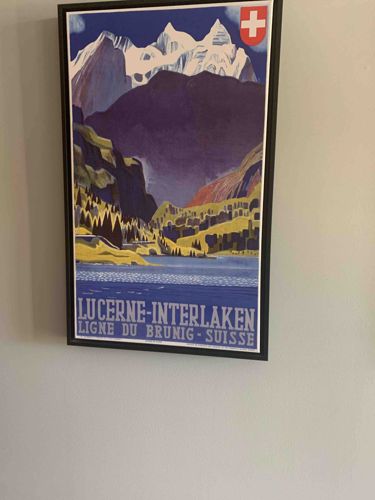
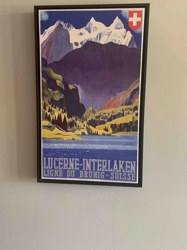
This item is a framed vintage travel poster featuring a vivid depiction of the Swiss landscape. The primary colors are deep blues, purples, greens, and yellows, creating a striking contrast that is characteristic of early to mid-20th-century travel advertising. The poster illustrates a serene lake in the foreground, likely one of the Swiss lakes, with the text 'LUCERNE-INTERLAKEN' prominently displayed below, suggesting the specific travel route or destinations promoted. Below this, 'LIGNE DU BRUNIG - SUISSE' further specifies the Brünig railway line in Switzerland, indicating the poster's purpose as an advertisement for railway travel. In the background, majestic, snow-capped mountains loom, rendered in a stylized, somewhat abstract manner, conveying their grandeur without excessive detail. A notable feature is the Swiss flag (red with a white cross) in the upper right corner, clearly identifying the country. The overall artistic style appears to be Art Deco or a similar period, characterized by bold lines, strong geometric shapes in the landscape elements (particularly the mountains and valleys), and a simplified color palette often used in lithographic printing of the era. The poster is encased in a simple, flat black frame, which appears to be a modern addition, providing a clean border to the artwork. The condition of the poster itself, while difficult to ascertain fully through the image, appears good, with no obvious major tears, creases, or significant discoloration. Any minor wear or patina would be expected for an item of its likely age, which could be estimated to be from the 1920s to 1950s, given the typical design trends for travel posters. The craftsmanship is evident in the clear typography and consistent color application, indicative of professional printing techniques for commercial advertising.
AI Appraisal Report
Upon examining the provided image of the vintage travel poster, 'Lucerne-Interlaken Ligne du Brunig - Suisse', I have assessed its value based on visual characteristics and current market conditions. The poster exhibits a strong Art Deco style, popular from the 1920s to the 1940s, characterized by its bold colors and stylized depiction of the Swiss landscape. The typography and composition are consistent with authentic travel posters from this era. The condition appears to be good, with vibrant colors and no visible major flaws like tears or water damage, though a closer, in-person inspection is necessary to confirm the absence of minor foxing, tears, or repairs. The modern black frame, while suitable for display, does not add to the intrinsic value of the piece itself.
Market demand for authentic early to mid-20th-century Swiss travel posters remains strong among collectors. Comparable posters from the Brünig line or by similar artists of the period often sell for a significant sum, contingent on condition, rarity, and artist attribution (which is not visible here). The lack of a visible artist's signature is a key factor that tempers the value, as posters by renowned artists like Herbert Matter or Martin Peikert can command much higher prices.
It is crucial to note that this appraisal is based solely on digital images. Full authentication would require physical examination to assess the paper quality, printing technique (likely stone lithography), and any hidden condition issues. Verifying the printer's mark and obtaining any provenance documentation would be essential steps to confirm its authenticity and establish a more definitive value.