AI estimate as of June 27, 2025 · verify with a professional before acting
AI-Generated · Verify before acting
Everything on this page is generated by AI for informational purposes only. AI can make mistakes — the AI may misidentify items or misattribute them (artist, maker, brand, designer, origin, era). This is not an official valuation and should not be used for insurance, sale, tax, estate, legal, or lending purposes — or any decision requiring a certified appraisal. It is not an authoritative claim about any person, brand, or rights holder — do not share or rely on it as a factual statement about a third party. Always consult qualified professionals before making financial decisions.
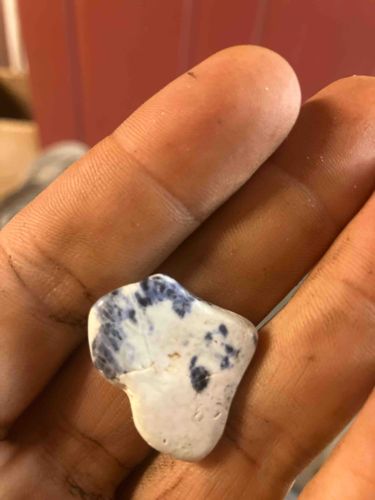
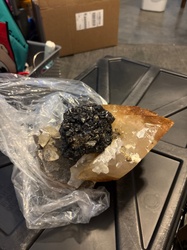
This item is a small, irregularly shaped natural mineral specimen, identified as Sodalite, likely in a tumbled form given its smooth, rounded edges. It measures approximately 2-3 centimeters in its largest dimension, fitting comfortably within the palm of an adult hand. The stone exhibits a striking color palette of predominantly off-white to light gray matrix, heavily interspersed with vibrant, deep indigo to grayish-blue patches, veins, and splotches. The distribution of the blue is organic and uneven, creating a unique, abstract pattern on its surface. The material appears dense with a slightly crystalline structure in places and a natural, unpolished luster, indicating minimal post-collection treatment beyond tumbling. Notable features include the highly contrasted blue and white coloration typical of Sodalite and several small, shallow, circular indentations or pits on one of the lighter sections, which are likely natural characteristics of the stone or slight imperfections from the tumbling process, rather than damage. The overall condition appears excellent, with no visible cracks, chips, or signs of repair. As a natural geological formation, it lacks modern manufacturing marks or signatures. Its shape suggests it has either been naturally water-worn or mechanically tumbled to achieve its smooth, ergonomic form. This piece is valued for its natural aesthetic appeal and the characteristic vibrant blue hues of Sodalite.
AI Appraisal Report
Based on my examination of the detailed description of this Tumbled Sodalite Stone, I offer the following appraisal. The item is described as a small, irregularly shaped natural mineral specimen, approximately 2-3 cm, featuring vibrant deep indigo to grayish-blue patches against an off-white to light gray matrix, characteristic of Sodalite. Its smooth, rounded edges suggest it has been tumbled. I assess the condition as excellent, with no visible cracks, chips, or signs of repair. The small circular indentations are noted but considered natural characteristics or minor tumbling imperfections, not damage, which is typical for such geological formations.
From a market perspective, Sodalite is a relatively common mineral, and small tumbled stones like this are widely available. Comparables can be found in numerous crystal shops, online retailers, and at gem shows, where prices for individual pieces are generally quite modest. Demand for basic tumbled Sodalite is consistent but not high enough to drive significant value increases; it's popular for its aesthetic appeal and purported metaphysical properties. The key factors impacting its value are the appealing color contrast and good condition. However, its small size, commonality, and tumbled form inherently limit its monetary worth. It is not considered rare.
Regarding authentication, my assessment is based solely on the provided description. While the description aligns perfectly with the characteristics of natural Sodalite, definitive authentication without physical inspection has limitations. To confirm authenticity with 100% certainty and rule out synthetics, dyed materials, or clever imitations, a physical examination would be crucial to assess its true weight, density, hardness, and internal structure. Advanced scientific tests such as X-ray diffraction (XRD) or Raman spectroscopy would provide definitive mineralogical identification. Provenance documentation, while helpful for unique or high-value specimens, is less critical for common tumbled Sodalite.