These notes were written by the person who submitted this item. Appraiser.AI has not verified them, and the AI's identification and estimate may rely on them.
AI Estimated Value
Not an official valuation
$1,500-2,500
AI estimate as of August 10, 2025 · verify with a professional before acting
AI-Generated · Verify before acting
Everything on this page is generated by AI for informational purposes only. AI can make mistakes — the AI may misidentify items or misattribute them (artist, maker, brand, designer, origin, era). This is not an official valuation and should not be used for insurance, sale, tax, estate, legal, or lending purposes — or any decision requiring a certified appraisal. It is not an authoritative claim about any person, brand, or rights holder — do not share or rely on it as a factual statement about a third party. Always consult qualified professionals before making financial decisions.
This analysis also relies on unverified notes provided by the user, which may be incomplete or inaccurate and could affect the result.
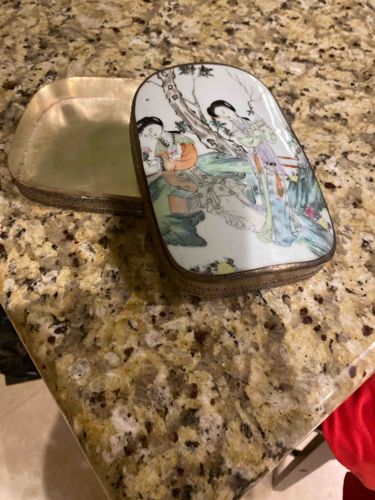
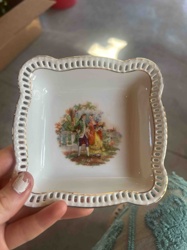
This is an antique Chinese porcelain box with a metal-bound rim. The box is rectangular with softly rounded corners, indicating a refined craftsmanship. The lid features a vibrant polychrome enamel painting depicting two figures, likely court ladies or mythological beings, amidst a tree and landscape elements. The colors used are rich and varied, including distinct shades of green, blue, brown, orange, and black, typical of 'Famille Verte' or similar enamel palettes from the Qing Dynasty. The figures are rendered with delicate details, showcasing their traditional attire and hairstyles. The white porcelain ground of the lid provides a stark contrast, allowing the painted scene to stand out. The metal binding, which appears to be brass or an alloy that has developed a dark patina, indicates considerable age and serves to protect the porcelain edges. The base of the box, visible in the background, is a simple, polished metal, possibly mother-of-pearl or shell, or a lustrous metallic material. The overall condition appears good for its age, though the metal rim shows some wear and tarnish consistent with antique pieces. There are no immediately obvious chips or cracks in the porcelain from the visible angles. The quality of the painting suggests a skilled artisan and the overall construction points to a high-quality item, likely from the Qing Dynasty (1644-1912).
AI Appraisal Report
I have examined the provided image of the Chinese Porcelain and Metal-Bound Box with Figural Painting. Based on the visual evidence, the box exhibits characteristics consistent with a Qing Dynasty (1644-1912) piece, likely executed in the 'Famille Verte' palette. The detailed polychrome enamel painting, depicting two figures amidst a landscape, shows skilled artistry. The metal binding, appearing to be brass with a dark patina, aligns with antique construction. The overall condition appears good for its age, with expected wear and tarnish on the metal but no immediately obvious chips or cracks visible in the porcelain.
In terms of market conditions, antique Chinese porcelain, particularly well-preserved pieces with desirable figural decoration, maintains a steady demand. Comparable 'Famille Verte' boxes from the Qing Dynasty have achieved prices in auction and retail settings, often depending on the rarity of the specific design, the quality of enameling, and provenance. This piece's intricate painting and apparent good condition contribute positively to its appeal.
However, it is crucial to note the limitations of appraising from images alone. While consistent with the Qing Dynasty, definitive authentication between Ming and Qing and precise dating require in-person examination. I would need to physically inspect the porcelain for manufacturing techniques, the precise glazes and enamels used, the nature of the metal binding and its attachment, and any maker's marks or inscriptions. Thorough scientific testing, such as thermoluminescence dating, and robust provenance documentation would further solidify its authenticity and precise age, significantly impacting the value. Without these, the assessment remains based on visual characteristics and historical context.
Considering the visible quality and typical market trends for comparable items, a preliminary appraisal value can be established, acknowledging the need for further verification.