AI estimate as of October 17, 2025 · verify with a professional before acting
AI-Generated · Verify before acting
Everything on this page is generated by AI for informational purposes only. AI can make mistakes — the AI may misidentify items or misattribute them (artist, maker, brand, designer, origin, era). This is not an official valuation and should not be used for insurance, sale, tax, estate, legal, or lending purposes — or any decision requiring a certified appraisal. It is not an authoritative claim about any person, brand, or rights holder — do not share or rely on it as a factual statement about a third party. Always consult qualified professionals before making financial decisions.
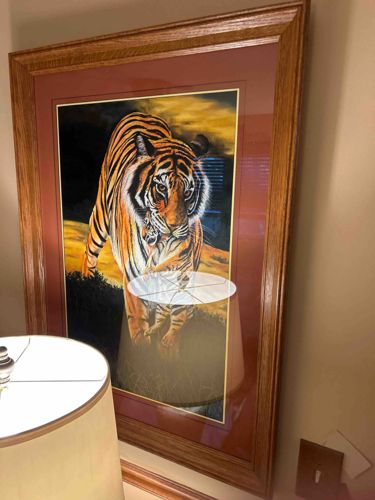
This item is a framed piece of artwork depicting a tiger. The artwork itself appears to be a print or a detailed rendering, possibly an acrylic or oil painting on canvas or board, featuring a majestic tiger in a natural setting. The tiger is rendered in vibrant orange, black, and white tones, with a contemplative or focused expression, positioned in what looks like a shadowy, possibly grassy foreground with a glowing, warm-toned background that transitions from yellow to amber. A notable visual element within the artwork is the reflection of the tiger's head and upper body on a glassy or watery surface in the foreground, creating depth and visual interest. The artwork is housed within a substantial wooden frame, likely oak or a similar grain with a medium-brown stain, exhibiting a classic, somewhat ornate profile with multiple stepped or ridged edges. The inner perimeter of the frame features a wide, reddish-brown mat that complements the earthy tones of the artwork. Over the artwork, there is a protective glass or acrylic glazing, as evidenced by the clear reflections of a lamp and possibly the room's lighting. The overall condition appears good, with no obvious signs of damage to the frame or the artwork itself, though the reflections on the glass obscure some details. The framing seems professionally done, indicating a piece intended for display. The style suggests a realistic or photorealistic approach, possibly from the late 20th century to early 21st century.
AI Appraisal Report
Based on my visual examination of the provided image, this framed tiger artwork appears to be in good overall condition. The artwork itself, likely a print or detailed reproduction, showcases a majestic tiger with a compelling reflection, suggesting a realistic or photorealistic style. The colors are vibrant, and there are no immediately apparent flaws in the artwork. The framing is substantial and appears professionally executed, featuring a tasteful wooden frame with an attractive reddish-brown mat that complements the piece. The protective glazing shows reflections, which, while indicating its presence, also obscure some finer details of the artwork.
Authenticity, when assessing a print or reproduction, largely pertains to the quality of the print and the reputation of the artist or publisher. Without a signature, edition number, or publisher's mark, it's impossible to verify its origin or whether it's an open edition or a limited-edition print from the image alone. The style suggests it could be from the late 20th century to early 21st century, a period when such realistic wildlife art was popular for decorative purposes.
The market for decorative framed prints, even high-quality ones, is generally stable but not exceptionally strong for appreciation, unless it's a signed, limited-edition piece by a renowned artist. Comparable pieces often sell in the low to mid-hundreds, particularly when unframed or with less substantial framing. The demand for wildlife art remains consistent, but rarity is not a significant factor here without provenance. The quality of the framing adds to the value, representing a significant portion of its appraisal. My valuation considers it as a good quality decorative print, well-framed and in good condition.
To definitively authenticate its origin, determine if it's an original painting, a signed limited-edition print, or a mass-produced print, I would require a physical in-person examination. This would allow for close inspection of the medium, signature (if any), edition number, and evaluation of the print quality. Analysis of the reverse side for labels or artist information would also be crucial. Without such access, my assessment is limited to its aesthetic and decorative value as depicted in the image.