These notes were written by the person who submitted this item. Appraiser.AI has not verified them, and the AI's identification and estimate may rely on them.
AI Estimated Value
Not an official valuation
$150-$300
AI estimate as of September 23, 2026 · verify with a professional before acting
AI-Generated · Verify before acting
Everything on this page is generated by AI for informational purposes only. AI can make mistakes — the AI may misidentify items or misattribute them (artist, maker, brand, designer, origin, era). This is not an official valuation and should not be used for insurance, sale, tax, estate, legal, or lending purposes — or any decision requiring a certified appraisal. It is not an authoritative claim about any person, brand, or rights holder — do not share or rely on it as a factual statement about a third party. Always consult qualified professionals before making financial decisions.
This analysis also relies on unverified notes provided by the user, which may be incomplete or inaccurate and could affect the result.
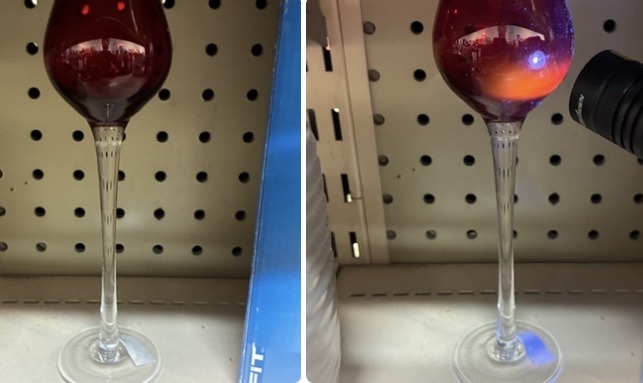
This piece of glassware features a deep cranberry or ruby red bowl resting on a clear, slender, faceted stem and a circular foot. The stem exhibits internal decorative elements, possibly air twist or pressed patterns, which catch the light. The bowl is bulbous and tapering towards the rim, displaying a rich red hue characteristic of traditional glassmaking techniques utilizing gold chloride. The item appears to be in generally good visual condition with no glaring chips or cracks immediately apparent from the photos, though minor surface wear cannot be ruled out without physical inspection. The owner provided context describing the item as a 'Loquet', but this user-supplied attribution is unverified and not directly supported by any visible maker's marks or stamps in the photographs. The style is consistent with mid-to-late 19th-century or 20th-century European art glass or tableware, showing craftsmanship typical of Victorian or later decorative glassware. There are no clearly legible maker's marks, signatures, or acid etchings visible in the provided imagery, meaning the identification is based strictly on physical characteristics, color, and form rather than a confirmed brand attribution.
AI Appraisal Report
Based on what I can see in the provided imagery, this piece of glassware features a deep cranberry or ruby red bowl resting on a clear, slender, faceted stem and circular foot, consistent with traditional glassmaking techniques. The owner identifies this as a 'Loquet', but this user-supplied attribution remains unverified, as I cannot locate any visible maker's marks, signatures, or stamps in the photographs. Based on the assumption that the owner's attribution to Loquet is correct, an item of this type typically commands a value in the range of $150 to $300, depending on precise age, condition, and market demand for Victorian or later decorative art glass. However, I can't verify materials, exact age, or manufacture from a photo alone, and would need physical inspection to confirm condition and craftsmanship. If the piece turns out to be a reproduction, a later replica, or simply made 'in the style of' rather than by the suggested maker, the market value would drop significantly, likely falling into the $40 to $80 range as generic decorative tableware. To establish authenticity and a more precise valuation, one would need an in-person examination by a qualified specialist, detailed provenance documentation, and careful scrutiny for subtle hallmarks or studio signatures that may not be visible in digital images.