AI estimate as of December 13, 2025 · verify with a professional before acting
AI-Generated · Verify before acting
Everything on this page is generated by AI for informational purposes only. AI can make mistakes — the AI may misidentify items or misattribute them (artist, maker, brand, designer, origin, era). This is not an official valuation and should not be used for insurance, sale, tax, estate, legal, or lending purposes — or any decision requiring a certified appraisal. It is not an authoritative claim about any person, brand, or rights holder — do not share or rely on it as a factual statement about a third party. Always consult qualified professionals before making financial decisions.
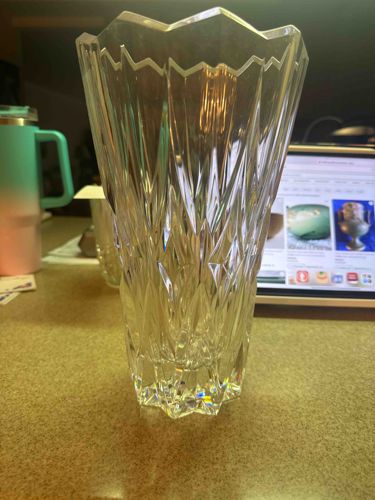
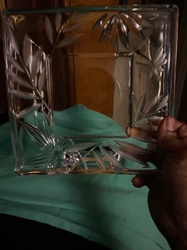
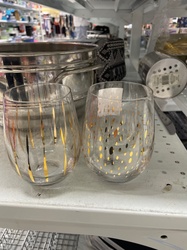
This is a clear, cut crystal vase, designed for holding flowers. The vase is characterized by its geometric, faceted cuts that run vertically along its body, creating a striking play of light and shadow, and refracting ambient light into prismatic colors, especially visible near the base. The material appears to be high-quality lead crystal, indicated by its clarity, brilliance, and the sharp, precise angles of the cuts. The overall shape is a flared cylindrical or conical form, widening slightly towards the top. The rim of the vase is uniquely scalloped or zigzag-shaped, adding an intricate detail that distinguishes it from more common smooth-rimmed vases. The base of the vase is substantial and also heavily faceted, providing stability and contributing to the item's overall sparkling aesthetic. There are no visible chips, cracks, or significant abrasions on the surface, suggesting it is in excellent condition. No specific maker's marks or signatures are discernable from the provided image. Based on its style and craftsmanship, it likely dates from the late 20th century, possibly a decorative item from a known crystal manufacturer. The intricate cutting and polished surfaces suggest a well-made, possibly machine-cut but finely finished piece of decorative glassware.
AI Appraisal Report
I have examined the provided image of the cut crystal flower vase. Based on its visual presentation, the vase appears to be in excellent condition, with no visible chips, cracks, or significant abrasions. The clarity, brilliance, and sharp, precise angles of the cuts strongly suggest it is made from high-quality lead crystal, or at least a very good quality lead-free crystal. The intricate scalloped rim and substantial, faceted base contribute to its decorative appeal and perceived quality. The style, particularly the geometric cuts and overall form, is consistent with decorative glassware produced in the late 20th century. While it exhibits fine craftsmanship, the intricate and repeatable nature of the cuts suggests it was likely machine-cut and finely polished, rather than entirely hand-cut, which is common for this period.
Market conditions for cut crystal vases of this type are generally moderate. While there is a steady demand for elegant decorative items, the market is also somewhat saturated with similar pieces, especially those without a distinguished maker's mark or documented provenance. Comparables for unsigned, high-quality decorative crystal vases from the late 20th century typically fall within the $75 to $150 range in the secondary market. Factors that significantly impact its value would be the identification of a specific high-end manufacturer (e.g., Baccarat, Waterford, Steuben) or a unique, artisanal design. The lack of discernable maker's marks or signatures limits its value to that of a decorative, high-quality, but generic crystal piece.
It is crucial to note the limitations of determining authenticity and full value from images alone. While its condition appears excellent, a physical examination would be necessary to confirm the absence of any micro-chips, interior scratches, or damage not visible in the image. In-person examination would also allow for a 'ping test' to confirm the crystal's lead content (if applicable), and a thorough search for any subtle acid etchings or marks that might identify the manufacturer. Provenance documentation, such as original sales receipts or certificates, would significantly enhance its value by confirming its origin and potentially its manufacturer, which is not possible through visual inspection alone.