AI estimate as of July 24, 2025 · verify with a professional before acting
AI-Generated · Verify before acting
Everything on this page is generated by AI for informational purposes only. AI can make mistakes — the AI may misidentify items or misattribute them (artist, maker, brand, designer, origin, era). This is not an official valuation and should not be used for insurance, sale, tax, estate, legal, or lending purposes — or any decision requiring a certified appraisal. It is not an authoritative claim about any person, brand, or rights holder — do not share or rely on it as a factual statement about a third party. Always consult qualified professionals before making financial decisions.
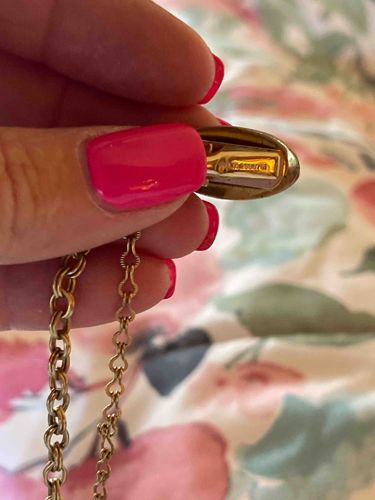
The item in question appears to be a vintage or antique jewelry clasp, specifically a spring ring or similar closure mechanism, attached to a chain. The clasp itself is oval-shaped, made of a warm-toned yellow metal, likely gold, gold-filled, or gold-plated, given its aged appearance and the 'Howard' marking. The surface of the clasp exhibits a slight patina consistent with age, suggesting it is not newly manufactured. The visible marking 'Howard' is etched or stamped into the metal of the clasp's inner mechanism. This could indicate the manufacturer of the clasp component or the entire piece of jewelry. The chain attached to the clasp consists of two distinct styles: one section features a classic oval link chain, while the other is comprised of delicate, heart-shaped or figure-eight links, suggesting an decorative or elegant design for the full piece of jewelry. Both chain sections are also in a matching yellow metal. The overall quality of construction appears to be good, with no obvious signs of severe damage or repair. The spring mechanism of the clasp seems to be intact, though its functionality cannot be fully assessed from the image alone. The presence of the 'Howard' mark is a key feature for identifying the maker and potentially dating the piece. Based on the style of the chain and clasp, it is likely from the early to mid-20th century, possibly Art Deco or Retro period, though more information about the full piece of jewelry would be needed for a precise dating.
AI Appraisal Report
Upon examining the provided image of the Vintage 'Howard' Stamped Jewelry Clasp with Chain Sections, I can offer the following professional appraisal. The clasp, a spring-ring type, shows an appealing warm-toned yellow metal, consistent with gold, gold-filled, or plated material. The visible 'Howard' stamp is a significant feature, indicating a potential manufacturer. The patina suggests genuine age, likely early to mid-20th century. The attached chain sections, one oval-link and one decorative heart/figure-eight, contribute to the component's visual appeal. Condition appears good; the clasp mechanism seems intact, and there are no obvious severe damages.
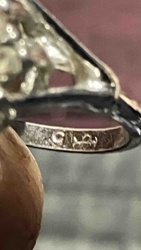
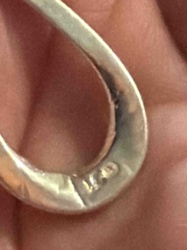
Authenticity of the 'Howard' mark, while visually present, cannot be definitively verified without in-person examination. From the image alone, I cannot confirm if "Howard" refers to a well-known jewelry maker or a more obscure manufacturer. This significantly impacts potential value. Market conditions for vintage jewelry components vary widely. Unidentified or common 'Howard' marked clasps might have limited demand, valued primarily for their metal content if solid gold, or as repair parts. However, if 'Howard' refers to a reputable maker (e.g., E. Howard & Co. historically made watches, though it's less known for jewelry components), or if this clasp was part of a significant piece, rarity and demand would increase.
Factors significantly impacting value include the type of metal (solid gold would be the primary driver), the actual significance of the 'Howard' mark, and the weight of the metal. Without knowing the metal purity/type, determining a precise value is challenging. The current market for generic vintage clasps is modest.
Limitations in authenticity verification are paramount. To fully authenticate, I would need a physical examination to test the metal composition (e.g., acid test, XRF), confirm the stamping method for authenticity, and potentially research the 'Howard' mark in jewelry historical records. Provenance documentation, if available, would also be crucial. For these reasons, my appraisal is based on the visible characteristics alone, assuming typical vintage components.