These notes were written by the person who submitted this item. Appraiser.AI has not verified them, and the AI's identification and estimate may rely on them.
AI Estimated Value
Not an official valuation
$150-300
AI estimate as of August 31, 2025 · verify with a professional before acting
AI-Generated · Verify before acting
Everything on this page is generated by AI for informational purposes only. AI can make mistakes — the AI may misidentify items or misattribute them (artist, maker, brand, designer, origin, era). This is not an official valuation and should not be used for insurance, sale, tax, estate, legal, or lending purposes — or any decision requiring a certified appraisal. It is not an authoritative claim about any person, brand, or rights holder — do not share or rely on it as a factual statement about a third party. Always consult qualified professionals before making financial decisions.
This analysis also relies on unverified notes provided by the user, which may be incomplete or inaccurate and could affect the result.
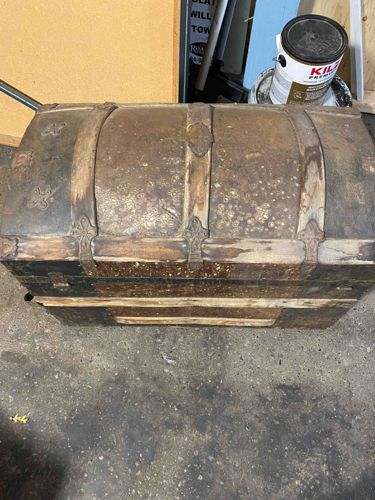
This is an antique or vintage dome-top trunk, often referred to as a camelback trunk due to its distinctive curved lid. The trunk appears to be constructed primarily of wood, likely pine or similar common wood, reinforced and covered with metal cladding, possibly tin or iron, which shows significant rust and wear. The metal surfaces exhibit an embossed or pressed decorative pattern, which is heavily obscured by oxidation and pitting, giving it a mottled, dark brown and reddish-brown appearance with lighter, almost gold-colored highlights where the original finish or a lighter metal might be visible beneath the corrosion. The trunk is reinforced with multiple wooden slats, some of which appear to be original and others possibly replacements or repairs, running horizontally around the body and vertically over the dome top. These wooden elements are dark brown, weathered, and show signs of age-related cracking and discoloration from moisture exposure. Ornate cast metal hardware, including L-shaped corner protectors and decorative escutcheons or strap terminals, are visible, particularly on the top and sides reinforcing the wooden bands. These metal accents show similar levels of rust and patina as the main body. The trunk's overall condition suggests long-term exposure to varying environmental conditions, with significant surface degradation, rust, and possible wood rot or decay, particularly on the lower edges and base. No obvious maker's marks or signatures are discernible from the image. The style points to a late 19th to early 20th century manufacturing period, typical of personal luggage for travel during that era. The level of craftsmanship, while difficult to ascertain fully due to condition, appears to be utilitarian for its original purpose, with a focus on durability rather than fine artistry, though the embossed metalwork adds a decorative touch. Its current state indicates it would require extensive restoration to return to its original aesthetic.
AI Appraisal Report
Based on my visual examination of the provided image, this Dome-Top Trunk, often referred to as a camelback trunk, exhibits significant signs of age and wear. The construction, primarily wood reinforced with embossed metal cladding, is consistent with late 19th to early 20th-century travel trunks. The heavy rust, pitting, and obscured decorative patterns on the metal, along with the weathered, discolored wooden slats, indicate long-term exposure to harsh environmental conditions. The hardware shows similar levels of corrosion.
The authenticity, based on style and apparent construction methods, seems consistent with the period; however, without an in-person examination, I cannot definitively verify originality or rule out later modifications/repairs. Specifically, I would need to inspect the interior lining, check for maker's marks or labels often hidden within, assess the structural integrity of the wood (especially for rot or insect damage), and examine the fastening techniques for the metal and hardware.
From a market perspective, dome-top trunks are relatively common for this period. While popular for decorative purposes or light storage, the significant degradation of this example limits its appeal and value. Comparables in similar poor condition typically fetch lower prices. The extensive restoration required to bring this piece back to a desirable aesthetic significantly impacts its market value. Demand exists, but primarily for pieces in better original condition or those already professionally restored. The current state suggests it's more suited for a buyer seeking a project or a distressed antique look.
My valuation reflects its current, unrestored condition and the cost of necessary repairs. Without physical inspection to ascertain the full extent of hidden damage or structural compromise, this remains an estimate. Provenance documentation, if available, could offer additional authenticity insights but is unlikely to dramatically increase value given the current physical state.