AI estimate as of October 8, 2025 · verify with a professional before acting
AI-Generated · Verify before acting
Everything on this page is generated by AI for informational purposes only. AI can make mistakes — the AI may misidentify items or misattribute them (artist, maker, brand, designer, origin, era). This is not an official valuation and should not be used for insurance, sale, tax, estate, legal, or lending purposes — or any decision requiring a certified appraisal. It is not an authoritative claim about any person, brand, or rights holder — do not share or rely on it as a factual statement about a third party. Always consult qualified professionals before making financial decisions.
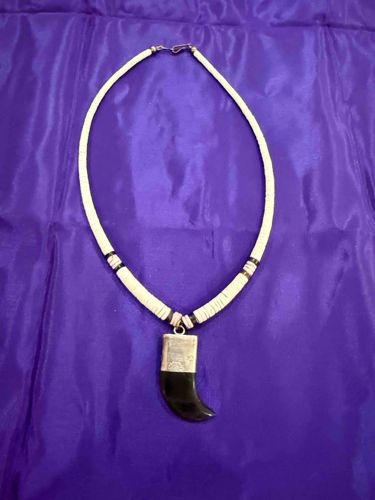
This is a necklace featuring puka shell beads and a horn-shaped pendant. The necklace consists of numerous flat, disc-shaped puka shell beads, which are off-white or cream in color, strung together to form the main body of the chain. These beads are uniform in size and neatly arranged, indicating a classic puka shell construction. Near the pendant, there are sections of smaller, dark-colored (likely black or dark brown) beads interspersed with the puka shells, possibly acting as spacers or decorative accents, lending a subtle contrast to the overall light-colored necklace. The central pendant is the focal point, characterized by its distinctive horn or claw shape. The top portion of the pendant is encased in what appears to be a silver-toned metal cap, possibly sterling silver or a silver alloy, which features some embossed or etched detailing on its surface, though the specifics of the design are not clearly discernible from the image. From this metal cap, a polished, jet-black, curved element hangs, resembling an animal horn or claw. The surface of this black element is smooth and lustrous, suggesting a polished finish, and it exhibits a gentle, natural curve. The necklace is secured with a simple hook-and-eye clasp, typical of costume jewelry or artisanal pieces. The overall condition appears good with no apparent major damage or repairs, though some minor wear consistent with use might be present on the metal or beads. The style suggests an indigenous, tribal, or bohemian aesthetic, likely dating from the mid-to-late 20th century to early 21st century. The craftsmanship is generally good, with the beads evenly strung and the pendant securely attached. The combination of natural materials like puka shell and horn with a metal component gives the piece a rustic yet refined appeal.
AI Appraisal Report
Based on my visual examination of the provided image, I assess this Puka Shell and Horn Pendant Necklace. The overall condition appears good, with the puka shells uniformly strung and the horn pendant securely attached. There are no overt signs of damage or significant wear, though minor surface abrasions on the beads or metal cap, consistent with age and use, cannot be ruled out without a physical inspection. Authenticity of the puka shells and horn appears genuine from the visual characteristics.
Market conditions for puka shell jewelry, particularly those combined with natural elements like horn, generally fall into the mid-range of artisanal or costume jewelry. Comparable pieces often retail between $30 and $150, depending on the quality of materials, craftsmanship, and perceived tribal or bohemian aesthetic. Demand for such pieces is steady among collectors of naturalistic or vintage-inspired jewelry, but it is not considered high-demand or rare. The metal cap's material, while appearing silver-toned, would require testing (e.g., acid testing or XRF analysis) to confirm if it is sterling silver or a base metal alloy, which significantly impacts value. Verification of the horn's origin (e.g., ethical sourcing) would also require documentation.
Without an in-person examination to assess the tactile quality of the materials, the exact nature of the metal, and any hidden flaws, or provenance documentation regarding the origin of the horn, it is challenging to provide a definitive higher-end valuation. My appraisal range reflects its current presentation as a well-preserved piece of decorative jewelry with natural components.