These notes were written by the person who submitted this item. Appraiser.AI has not verified them, and the AI's identification and estimate may rely on them.
AI Estimated Value
Not an official valuation
$2-4
AI estimate as of July 7, 2025 · verify with a professional before acting
AI-Generated · Verify before acting
Everything on this page is generated by AI for informational purposes only. AI can make mistakes — the AI may misidentify items or misattribute them (artist, maker, brand, designer, origin, era). This is not an official valuation and should not be used for insurance, sale, tax, estate, legal, or lending purposes — or any decision requiring a certified appraisal. It is not an authoritative claim about any person, brand, or rights holder — do not share or rely on it as a factual statement about a third party. Always consult qualified professionals before making financial decisions.
This analysis also relies on unverified notes provided by the user, which may be incomplete or inaccurate and could affect the result.
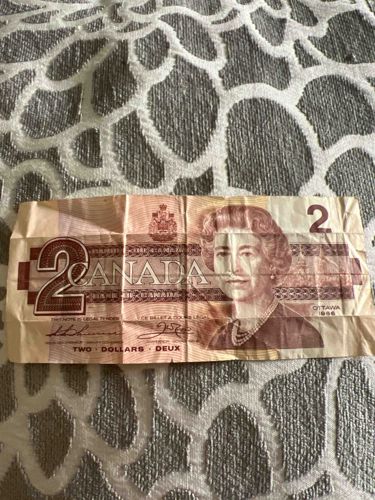
This item is a Canadian Two Dollar banknote, likely from the 1986 series, as indicated by the visible '1986' near the portrait. The bill features a portrait of Queen Elizabeth II on the right side of the obverse. The dominant color palette consists of various shades of brown and reddish-brown, along with some pinkish hues, printed on paper. The note displays the national name "CANADA" prominently in the center, above "BANK OF CANADA" and "BANQUE DU CANADA." Large numerals '2' are visible in the upper right and lower left corners. Along the bottom edge, it states "TWO DOLLARS" and "DEUX" (French for 'two'). There are also visible signatures, though they are difficult to discern clearly. The overall condition of the banknote shows significant signs of wear, including multiple folds, creases, and wrinkles across its surface. The paper appears soft and well-circulated, suggesting it has been extensively handled. There are no obvious tears or major rips, but the corners and edges exhibit softening and minor fraying. The ink appears stable with no major fading, but some areas of the portrait and text show slight discoloration due to handling. The general impression is one of a used, but intact, monetary instrument. Given its features and the visible date, it belongs to a series of Canadian banknotes that were in circulation between the mid-1980s and the late 1990s.
AI Appraisal Report
I have examined the provided image and description of this Canadian Two Dollar Bill, 1986 Series. Based on the visual evidence, the banknote appears to be authentic, consistent with known examples of the 1986 Series Canadian two-dollar notes, featuring Queen Elizabeth II. The color palette, design elements, and visible "1986" date align with this series.
However, the condition is the primary factor significantly impacting its value. The note exhibits considerable wear, including numerous folds, creases, and wrinkles, indicative of extensive circulation. While there are no apparent tears, the softening of the paper and minor fraying at the edges suggest a condition that would typically be graded in the 'Good' to 'Very Good' range by numismatic standards. Ink appears stable with no major fading, but general discoloration from handling is noted.
For most circulated, common-date banknotes, the numismatic premium over face value is minimal. The 1986 Canadian two-dollar note is not considered rare. Millions were printed and circulated before its gradual replacement by the toonie. Market conditions show low demand for common circulated examples of this particular series. Comparables for notes in similar condition typically sell for slightly above face value, if at all, to collectors who prefer higher-grade examples.
Limitations: My authenticity assessment is based entirely on the provided image and description. Without in-person examination, I cannot verify security features such as watermarks, microprinting, or paper feel. A physical inspection would also allow for a more precise condition grade and detection of any subtle repairs or alterations. Provenance documentation is not applicable here as these were mass-produced circulating notes. Scientific testing is not typically required for authenticating common, circulated banknotes of this era unless forgery is suspected, which is not indicated here.
Given the condition and commonality, this banknote holds minimal numismatic premium. The mention of a "Canadian half dollar" by the owner is irrelevant to the appraisal of this two-dollar note.