These notes were written by the person who submitted this item. Appraiser.AI has not verified them, and the AI's identification and estimate may rely on them.
AI Estimated Value
Not an official valuation
$80 - $150
AI estimate as of November 28, 2025 · verify with a professional before acting
AI-Generated · Verify before acting
Everything on this page is generated by AI for informational purposes only. AI can make mistakes — the AI may misidentify items or misattribute them (artist, maker, brand, designer, origin, era). This is not an official valuation and should not be used for insurance, sale, tax, estate, legal, or lending purposes — or any decision requiring a certified appraisal. It is not an authoritative claim about any person, brand, or rights holder — do not share or rely on it as a factual statement about a third party. Always consult qualified professionals before making financial decisions.
This analysis also relies on unverified notes provided by the user, which may be incomplete or inaccurate and could affect the result.
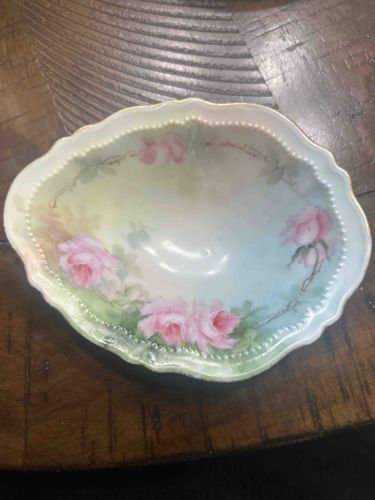
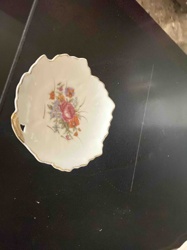
This is an exquisite hand-painted porcelain dish, likely an open candy dish, nut dish, or serving bowl, attributed to 'Royal Austria' based on the provided context. The dish features a distinctive scalloped rim, which is further embellished with small, raised ceramic beads, providing a delicate tactile detail. The primary decoration consists of vibrant pink roses with green foliage, hand-painted across the interior surface of the dish. The background of the painting transitions smoothly from a pale blue at the top to a light cream or ivory in the center, and a soft, verdant green at the bottom, mimicking a natural garden setting. The roses themselves are rendered with a painterly quality, showing varying shades of pink, indicating careful brushwork. A narrow gold gilt line traces the very edge of the scalloped rim, adding a touch of elegance and refinement to the piece. The construction appears to be fine porcelain, characterized by its smooth, glossy finish and translucent quality where visible. The overall condition appears good given its likely age, with no immediately obvious chips or cracks. Some minor wear to the gold gilt or slight crazing in the glaze might be present, but cannot be confirmed from the image. This type of decorative porcelain ware, particularly with floral motifs and gold accents, was very popular during the late 19th to early 20th century, suggesting an estimated age consistent with the Art Nouveau or Edwardian periods. The craftsmanship indicates a factory production base with individual hand-finishing, typical of quality European porcelain from that era. The 'Royal Austria' attribution, though a broad term, often refers to wares from manufacturers like 'Osterr. Porzellan-Industrie AG' or 'Hutschenreuther' which produced fine porcelain at that time.
AI Appraisal Report
Based on my visual examination of the provided image, this Royal Austria Hand-Painted Rose Motif Scalloped Dish presents as a charming example of late 19th to early 20th-century decorative porcelain. The hand-painted pink roses with green foliage, set against a transitioning blue, cream, and green background, are aesthetically pleasing and indicative of the era's popular floral motifs. The scalloped rim with raised ceramic beads and the delicate gold gilt line further enhance its decorative appeal. Its condition appears good overall for its age, with no immediate signs of major damage like chips or cracks apparent from the image. However, without a physical inspection, minor wear to the gilt, slight crazing in the glaze, or subtle restoration cannot be entirely ruled out.
Authenticity relies on the 'Royal Austria' attribution provided by the owner. While 'Royal Austria' broadly refers to quality Central European porcelain from that period, often associated with factories like Osterr. Porzellan-Industrie AG, a specific maker's mark on the base would be crucial for precise identification and authentication. Without seeing the base mark, full authentication cannot be achieved from an image alone. Market conditions for such decorative porcelain are generally stable but not experiencing rapid growth. Comparable items with good condition and clear maker's marks typically fetch in the $75-$175 range. The demand for hand-painted floral porcelain remains consistent among collectors of antique decorative arts, though rarity is moderate for general 'Royal Austria' wares. The lack of a specific factory mark, if absent, could slightly depress value.
To confirm authenticity and assess condition definitively, a physical examination is essential. This would allow me to inspect for hairline cracks, chips, wear to the gilding, and the presence or absence of a factory mark. Provenance documentation, if available, would also add significant weight to its history and authenticity. Scientific testing is generally not required for this type of item unless there are specific questions regarding materials or paint composition.