AI estimate as of November 7, 2025 · verify with a professional before acting
AI-Generated · Verify before acting
Everything on this page is generated by AI for informational purposes only. AI can make mistakes — the AI may misidentify items or misattribute them (artist, maker, brand, designer, origin, era). This is not an official valuation and should not be used for insurance, sale, tax, estate, legal, or lending purposes — or any decision requiring a certified appraisal. It is not an authoritative claim about any person, brand, or rights holder — do not share or rely on it as a factual statement about a third party. Always consult qualified professionals before making financial decisions.
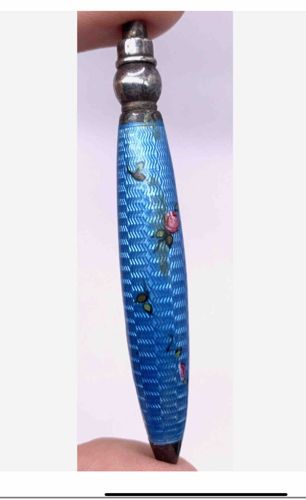
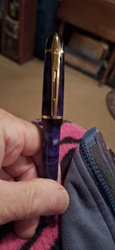
This is an exquisite Art Nouveau era chatelaine pencil, characterized by its vibrant blue guilloche enamel finish and sterling silver fittings. The pencil has an elongated, slender, and slightly tapering cylindrical form, designed to be decorative and functional. The main body of the pencil is meticulously decorated with a fine, wavy or engine-turned guilloche pattern beneath a translulcent, bright robin's egg blue enamel, which creates a captivating play of light and depth. Scattered across the blue enamel surface are hand-painted floral motifs, primarily depicting small pink roses with green foliage, adding a delicate and artistic touch. The top of the pencil features a sterling silver cap, which appears to be a finial for attachment to a chatelaine or a similar suspension mechanism; it has a rounded, bulbous element above a ribbed collar, and a smaller faceted top, possibly for a jump ring (not visible). The silver shows some tarnishing and minor surface wear consistent with age and use. The bottom tip of the pencil is dark, likely the lead mechanism, which is not fully extended or visible in detail. The craftsmanship suggests a high-quality piece, potentially European, dating from the late 19th to early 20th century. There are no visible maker's marks or signatures in the provided image, but such pieces often bear hallmarks on the silver. The enamel appears largely intact, though subtle variations in color and minor surface inconsistencies might be present upon closer inspection, indicative of its antique nature. The overall condition appears good for its age, showcasing detailed artistry typical of the period.
AI Appraisal Report
I have examined the image provided for this Art Nouveau Guilloche Enamel Chatelaine Pencil. Authenticity is strongly suggested by the design elements, particularly the classic Art Nouveau floral motifs and the guilloche enamel technique, which are consistent with the late 19th to early 20th century. The sterling silver components, though showing age-appropriate tarnishing, further support its period. Judging from the image, the enamel appears largely intact with vibrant color, a significant factor in value for such pieces. Slight surface wear and inconsistencies are expected given its age.
Market conditions for Art Nouveau collectibles, especially those combining precious metals and guilloche enamel, are stable with consistent demand from collectors of fine antique writing instruments, chatelaine accessories, and Art Nouveau decorative arts. Rarity is moderate; while guilloche enamel pieces are not exceedingly rare, a well-preserved chatelaine pencil with hand-painted details like this is less common than more utilitarian pieces.
Factors significantly impacting value include the excellent preservation of the colorful guilloche enamel, the intrinsic aesthetic appeal of the Art Nouveau design, and its functional nature as a writing instrument. Were the enamel significantly chipped, cracked, or dull, the value would be substantially lower. The absence of visible maker's marks or hallmarks, while not uncommon, does prevent attribution to a specific, potentially more valuable, artisan.
Limitations in authenticity verification from images alone are notable. A physical examination would be necessary to confirm the sterling silver content through hallmarking (which might be obscured or on an unpictured surface), assess the true condition of the enamel for any hairline cracks or repairs not visible here, and inspect the lead mechanism for functionality. Provenance documentation, if available, would provide invaluable historical context and further support authenticity. Scientific testing, such as XRF analysis for metal composition, would definitively confirm the material if hallmarking is absent or unclear.