AI estimate as of August 25, 2025 · verify with a professional before acting
AI-Generated · Verify before acting
Everything on this page is generated by AI for informational purposes only. AI can make mistakes — the AI may misidentify items or misattribute them (artist, maker, brand, designer, origin, era). This is not an official valuation and should not be used for insurance, sale, tax, estate, legal, or lending purposes — or any decision requiring a certified appraisal. It is not an authoritative claim about any person, brand, or rights holder — do not share or rely on it as a factual statement about a third party. Always consult qualified professionals before making financial decisions.
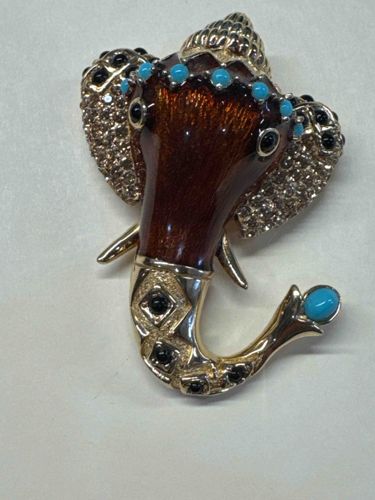
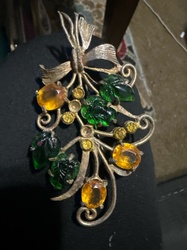
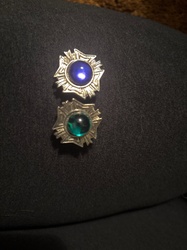
This item is a decorative brooch shaped like the head of an elephant, specifically depicting Ganesha, a Hindu deity. The brooch is predominantly gold-toned metal, likely a base metal alloy with a gold plating given its visual appearance. The main section of the elephant's head and trunk is covered in a rich, glossy reddish-brown enamel, providing a smooth and lustrous surface. The ears are adorned with numerous small, clear rhinestones, set closely together to create a sparkly, textured effect. Along the forehead and top of the trunk, there is a prominent row of small, round, sky-blue cabochon stones, likely simulating turquoise, which add a vibrant color contrast. Additional black cabochon stones, possibly onyx or black glass, are strategically placed, notably as the eyes and on the lower part of the trunk near the base. The lower section of the trunk, where it curves upwards, features decorative etched or raised patterns with more black cabochon stones set within diamond-shaped bezels. The tusks are subtly visible as small, curved, gold-toned protrusions emerging from either side of the trunk. The piece exhibits fine detailing in the casting for the gold-toned elements and the precise application of the enamel and stone settings, suggesting good craftsmanship suitable for costume jewelry. There are no immediately visible signs of significant damage like chips to the enamel or missing stones, though minor surface wear consistent with age and occasional use may be present upon closer inspection. The reverse side, although not visible, would typically feature a pin mechanism for attachment. The style suggests it could be from the mid to late 20th century, possibly in the range of the 1960s to 1980s, reflecting a cultural or symbolic theme often found in vintage costume jewelry.
AI Appraisal Report
Upon visual examination of the Ganesha Elephant Head Brooch, I assess its condition as very good to excellent given its likely age. The enamel appears intact and glossy, and all visible stones—rhinestones, blue cabochons, and black cabochons—seem to be present and securely set, with no apparent chips or significant wear visible from the image. The gold-toned metal components also show good integrity.
Authenticity: This piece presents as vintage costume jewelry, likely dating from the mid to late 20th century (1960s-1980s). Its design, materials (base metal, enamel, rhinestones, glass cabochons), and craftsmanship are consistent with common manufacturing practices for costume jewelry of that period.
Market Conditions and Comparables: Similar vintage costume brooches, especially those depicting cultural or symbolic themes like Ganesha, generally perform well in the secondary market. Comparables from well-known costume jewelry brands of the era (e.g., Napier, Monet, Trifari, though this piece lacks visible brand markings) tend to command higher prices. Generic, unbranded pieces rely more on aesthetic appeal and condition.
Demand and Rarity: There is a consistent demand for unique vintage brooches, particularly those with spiritual or animal motifs. While Ganesha brooches are not exceptionally rare, one in this condition and with such vibrant coloration holds good appeal. Its 'rarity' is more tied to its individual character than to limited production numbers.
Factors Impacting Value: The primary value drivers are the brooch's excellent visible condition, the attractive enamel work, and the appealing multi-stone accents. If the piece were signed by a recognized costume jewelry manufacturer, its value would significantly increase. Conversely, any hidden damage, missing stones on the reverse, or a faulty pin mechanism would decrease the value.
Limitations: My assessment is based solely on the provided image. Without a physical examination, I cannot definitively confirm the integrity of the reverse side (pin mechanism), the exact material composition of the metal (e.g., presence of lead or specific alloys), or the material of the stones (e.g., glass vs. plastic for cabochons). Microscopic examination could reveal minor scratches or enamel imperfections not visible in the photo. Provenance documentation, such as original purchase receipts or family history, would further solidify its authenticity and potential market appeal.