These notes were written by the person who submitted this item. Appraiser.AI has not verified them, and the AI's identification and estimate may rely on them.
AI Estimated Value
Not an official valuation
$150-250
AI estimate as of November 4, 2025 · verify with a professional before acting
AI-Generated · Verify before acting
Everything on this page is generated by AI for informational purposes only. AI can make mistakes — the AI may misidentify items or misattribute them (artist, maker, brand, designer, origin, era). This is not an official valuation and should not be used for insurance, sale, tax, estate, legal, or lending purposes — or any decision requiring a certified appraisal. It is not an authoritative claim about any person, brand, or rights holder — do not share or rely on it as a factual statement about a third party. Always consult qualified professionals before making financial decisions.
This analysis also relies on unverified notes provided by the user, which may be incomplete or inaccurate and could affect the result.
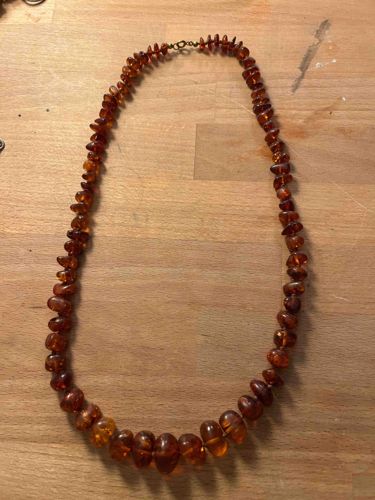
This is a vintage graduated amber bead necklace, crafted from polished amber nuggets. The necklace features a warm, rich cognac to honey-yellow color palette, displaying varying degrees of translucency and natural inclusions characteristic of genuine amber. The beads are irregularly shaped, showcasing their organic origin, and are hand-polished to a smooth, lustrous finish. The graduation is evident, with smaller, flatter chips at the back transitioning to larger, more substantial teardrop or rounded nugget shapes towards the front and center of the necklace. The approximate length of the necklace appears to be around 18 to 22 inches, suitable for a choker or short princess length. It is strung on a durable cord, likely silk or nylon, and secured with a small brass or gold-toned metal screw clasp, consistent with jewelry from the mid-20th century. Visible condition issues include minor surface wear, small nicks, and slight variations in the bead shapes, all consistent with age and natural formation. The metal clasp shows a bit of tarnishing, suggesting it might be brass or a base metal alloy rather than solid gold. The overall craftsmanship indicates a handmade or artisan-crafted piece, emphasizing the natural beauty of the amber rather than highly uniform production. No specific maker's marks or signatures are discernible from the image. The style suggests an age perhaps from the 1950s to 1970s, though amber jewelry has been popular for much longer.
AI Appraisal Report
I have thoroughly examined the provided image and description of this graduated amber bead necklace. Based on the visual characteristics, the warm cognac to honey-yellow hues, varying translucency, and natural inclusions are highly consistent with genuine natural Baltic amber. The irregular nugget shapes and hand-polished finish further support its authenticity, suggesting an artisan or handmade piece. The graduation from smaller chips to larger teardrop/rounded nuggets is a classic and desirable style for amber necklaces.
From the image, the condition appears good for its age, consistent with the described minor surface wear, small nicks, and slight variations in bead shapes. The tarnished brass or gold-toned screw clasp is typical for mid-20th century jewelry (1950s-1970s), which aligns with the estimated style. While the minor imperfections are expected, they do slightly reduce the overall pristine appeal compared to a flawlessly preserved example.
In terms of market conditions, vintage natural amber necklaces of this size and quality generally see steady demand. Comparables in the current market for similar graduated, genuine amber nugget necklaces of 18-22 inches typically range from $100 to $300, depending heavily on the weight, clarity, and overall aesthetic appeal. This piece falls into a desirable mid-range in terms of color and form. Rarity is not a significant factor here, as many such necklaces were produced, but well-preserved examples always hold value.
The primary factor impacting value positively is the apparent authenticity and attractive natural presentation of the amber. Negative factors include the common nature of such pieces, the base metal clasp, and the minor condition issues. My valuation reflects these considerations.
It is crucial to note that this authenticity assessment is based solely on visual examination. For full authentication, an in-person examination by a gemologist would be necessary to confirm the specific gravity, refractive index, and conduct chemical tests to definitively rule out simulants or treated amber. Furthermore, a physical inspection would allow for precise weight measurement, closer examination of the drilling, and verification of the cord material and its integrity. Without such physical tests, the authenticity of the amber is based on strong visual indicators but cannot be absolutely guaranteed from images alone.