AI estimate as of November 17, 2025 · verify with a professional before acting
AI-Generated · Verify before acting
Everything on this page is generated by AI for informational purposes only. AI can make mistakes — the AI may misidentify items or misattribute them (artist, maker, brand, designer, origin, era). This is not an official valuation and should not be used for insurance, sale, tax, estate, legal, or lending purposes — or any decision requiring a certified appraisal. It is not an authoritative claim about any person, brand, or rights holder — do not share or rely on it as a factual statement about a third party. Always consult qualified professionals before making financial decisions.
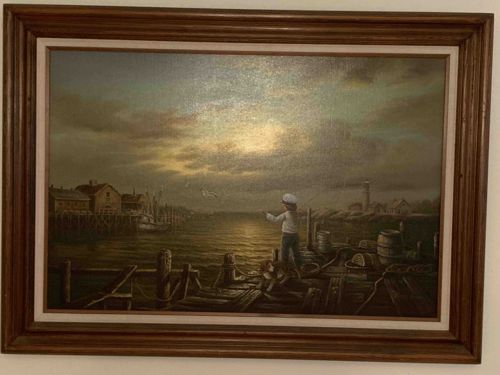
This item is an oil on canvas painting, depicting a serene coastal scene, likely at dusk or dawn, given the dramatic sky and the interplay of light on the water. The primary subject is a small child, dressed in a white shirt and blue pants with a white hat, standing on a wooden pier or dock, seemingly pointing towards the water or engaged in some activity. To the child's left, in the middle ground, there are several wooden barrels and other nautical paraphernalia, suggesting a working harbor. The pier itself appears weathered, with visible wood grain and dark, aged tones. In the background, on the left, a cluster of buildings with reddish-brown roofs and dark facades are visible along the coastline, indicative of a small fishing village or port. A small boat is moored near these structures. On the right side of the background, a distinctive lighthouse stands prominently, guiding ships, with additional settlement buildings scattered around it. The sky is dominated by a powerful, luminous glow, likely from the sun, breaking through dark, textured clouds, casting a reflection on the water that forms a path of light towards the viewer. One or two seagulls are captured in flight against this dramatic sky. The color palette is rich and moody, utilizing deep blues, greens, grays, and browns, punctuated by the warm glow of the sun and the lighter tones of the child's clothing. The texture of the paint, particularly in the sky and water, suggests visible brushstrokes, indicating an impressionistic or realistic style. The painting is housed in a substantial wooden frame with a decorative, molded profile and a medium-brown wood stain finish. The frame also includes a lighter, off-white or cream-colored inner liner, which provides a visual separation between the painting and the darker outer frame. There are no immediately apparent condition issues like major cracks, tears, or significant paint loss visible from the image, but a detailed inspection would be required to confirm this. The overall impression is one of a well-executed piece, possibly from the late 20th century, given the style and frame, aiming for a classic maritime aesthetic.
AI Appraisal Report
Based on my visual examination of the provided image, this oil on canvas painting, 'Seascape with Child and Lighthouse,' appears to be in good overall condition. I observe no obvious major cracks, tears, or significant paint loss. The frame, a substantial wooden type with a decorative molded profile and an inner liner, also seems well-maintained. The style, rich in moody colors and visible brushstrokes, suggests a late 20th-century piece, leaning towards an impressionistic or realistic maritime aesthetic. The vibrant interplay of light and shadow, especially in the dramatic sky, is a strong artistic element.
From a market perspective, works of this nature, if by an unlisted artist, generally fall into the decorative art category. While visually appealing, the lack of an identifiable artist or provenance limits its investment value. Comparable pieces by unknown artists achieving this level of detail and aesthetic quality typically fetch prices in the midrange of the decorative art market. Demand for well-executed scenic works remains steady, but rarity is not a factor here without artist identification.
Limitations regarding authenticity and definitive condition assessment are significant when based solely on images. Without an in-person examination, I cannot confirm the paint's age, whether it's truly oil on canvas, or detect subtle restorations, craquelure, or frame stability issues. Provenance documentation, such as artist signatures, exhibition history, or previous ownership records, would be crucial for full authentication and to attribute the work to a specific artist, significantly impacting its value. Scientific testing could also verify pigment composition and canvas age, if warranted.