AI estimate as of August 30, 2025 · verify with a professional before acting
AI-Generated · Verify before acting
Everything on this page is generated by AI for informational purposes only. AI can make mistakes — the AI may misidentify items or misattribute them (artist, maker, brand, designer, origin, era). This is not an official valuation and should not be used for insurance, sale, tax, estate, legal, or lending purposes — or any decision requiring a certified appraisal. It is not an authoritative claim about any person, brand, or rights holder — do not share or rely on it as a factual statement about a third party. Always consult qualified professionals before making financial decisions.
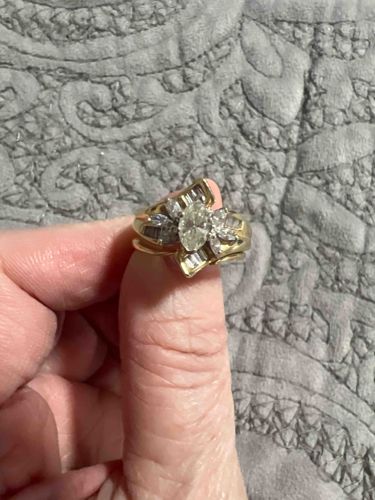
This item is a diamond ring, likely an engagement or wedding ring, composed of yellow gold. The central stone is an oval or marquise-cut diamond, approximately 0.75-1.0 carat based on visual estimation, held by multiple prongs. Flanking the central stone are various baguette-cut diamonds set in channels or invisible settings, creating a stepped or fan-like design. On either side of the central cluster, there appear to be additional round brilliant or smaller marquise-cut diamonds, set in what looks like white gold or platinum accents, enhancing the overall sparkle and design. The band is made of yellow gold and appears to be a solid construction. The overall style suggests a mid-to-late 20th century (possibly 1980s-1990s) design, characterized by the use of multiple diamond shapes and mixed metals (if the white accents are indeed a different metal). The metal shows some light surface wear consistent with regular use, but no significant damage or repairs are immediately visible. The diamonds appear clean and exhibit good brilliance, though a professional cleaning would likely enhance their luster. Given the intricate setting and variety of diamond cuts, it indicates a piece of good craftsmanship, designed to maximize the play of light.
AI Appraisal Report
Based on my visual examination of the provided image, I have assessed this Yellow Gold Multi-Diamond Ring with a Marquise/Oval Center Stone. The ring appears to be in good overall condition, showing light surface wear consistent with regular use but no obvious significant damage or repairs. The diamonds exhibit good brilliance, suggesting they are clean, though a professional cleaning would indeed enhance their luster.
The central stone, which I estimate to be between 0.75-1.0 carat, appears to be an oval or marquise-cut diamond. The surrounding baguette-cut and smaller round brilliant/marquise accents create an intricate, well-crafted design typical of the mid-to-late 20th century, likely 1980s-1990s. The yellow gold band appears solid, and the possible mix of white gold/platinum accents for the smaller diamonds adds to its appeal.
In terms of market conditions, vintage multi-diamond rings remain fairly desirable. While not exceedingly rare, the intricate design and combination of diamond cuts make this piece distinct. Demand generally favors classic designs, and this ring, with its timeless yet elaborate style, falls into a niche that attracts buyers looking for unique vintage pieces. Factors significantly impacting value include the actual carat weight, clarity, and color of the diamonds (especially the center stone), and the purity of the gold.
It is crucial to note the limitations of an image-based appraisal. I cannot definitively verify the authenticity of the diamonds as natural, nor can I accurately grade their specific characteristics (cut, color, clarity) or exact carat weights. The metal purity also cannot be confirmed. For full authentication and a precise valuation, an in-person examination by a certified gemologist is essential. This would involve a comprehensive evaluation of each diamond using gemological tools, verification of the metal content, and a thorough assessment of the setting's integrity. Provenance documentation, if available, would also be invaluable in confirming the ring's history and potential origin.