AI estimate as of September 3, 2025 · verify with a professional before acting
AI-Generated · Verify before acting
Everything on this page is generated by AI for informational purposes only. AI can make mistakes — the AI may misidentify items or misattribute them (artist, maker, brand, designer, origin, era). This is not an official valuation and should not be used for insurance, sale, tax, estate, legal, or lending purposes — or any decision requiring a certified appraisal. It is not an authoritative claim about any person, brand, or rights holder — do not share or rely on it as a factual statement about a third party. Always consult qualified professionals before making financial decisions.
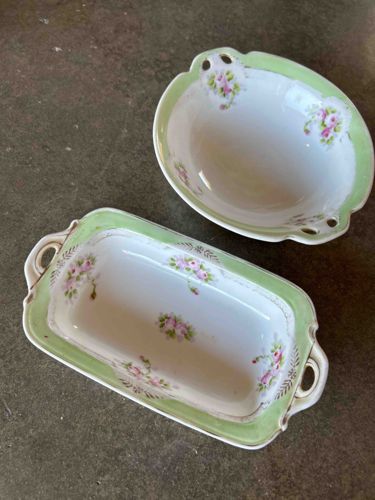
This is a set of two antique or vintage porcelain serving dishes, likely intended for individual or small-portion servings, possibly for nuts, candies, or relishes. Both pieces feature a delicate, scalloped rim design with pierced handles on the oval dish and solid handles on the rectangular dish, showcasing an elegant, ornate aesthetic. The primary color scheme is white porcelain with a wide band of soft, pale green on the exterior edges and rims. Each dish is adorned with charming clusters of hand-painted pink roses and green foliage, unevenly distributed but concentrated in certain areas of the interior and rim. Fine gold accent lines are visible along the edges of the green bands and the handles, adding a touch of luxury. The craftsmanship appears to be of good quality, typical of turn-of-the-century or early 20th-century European porcelain, possibly Bavarian or French, characterized by its fine detail and floral motifs. There are no visible chips, cracks, or significant damage, though some light wear to the gold trim or slight fading of the rose decals, consistent with age, might be present upon closer inspection. The overall condition appears good, suggesting careful handling over the years. The style period points towards late Victorian or Edwardian eras, valuing intricate designs and naturalistic elements. The absence of visible maker's marks prevents precise dating or identification of the origin, but the style is characteristic of fine porcelain produced during these periods.
AI Appraisal Report
Based on my visual examination of the provided image, this pair of antique pale green floral porcelain relish/serving dishes exhibits characteristics consistent with late Victorian or Edwardian era decorative tableware. The scalloped rims, pierced and solid handles, soft pale green banding, hand-painted pink roses with green foliage, and delicate gold accents are all typical of fine porcelain produced during this period, likely from European manufacturers, possibly Bavarian or French. The overall condition appears to be good; I can discern no obvious chips, cracks, or significant damage from the image. While the craftsmanship seems good, without physical inspection, I cannot ascertain the extent of wear to the gold trim or potential fading of the rose motifs, which often occurs with age and use. Authenticity, in terms of period and style, seems plausible, but the absence of visible maker's marks is a significant limitation. For full authentication, I would require an in-person examination to search for hidden marks, assess the porcelain quality and painting technique closely, and potentially perform scientific testing on the materials for precise dating. Provenance documentation, if available, would also be crucial.
In terms of market conditions, similar hand-painted floral porcelain serving pieces from the turn of the century are currently in modest demand. While aesthetically pleasing, they are not exceedingly rare unless attributed to a highly coveted manufacturer. Comparable sales for unmarked or lesser-known European floral porcelain dishes of this type typically fall within the $60-$90 range per piece. The attractive condition and matching pair contribute positively to value. Factors that would significantly impact value upward include identification of a prominent manufacturer (e.g., Limoges, Meissen, Dresden, Royal Vienna), exceptional condition, or unique design elements. Conversely, any hidden damage, extensive wear, or confirmation of non-European origin (unless equally desirable) would lower the value. Given the current market and the limitations of image-only appraisal, I estimate a retail appraisal value of $120-$180 for the pair.