These notes were written by the person who submitted this item. Appraiser.AI has not verified them, and the AI's identification and estimate may rely on them.
AI Estimated Value
Not an official valuation
$600-900
AI estimate as of September 2, 2025 · verify with a professional before acting
AI-Generated · Verify before acting
Everything on this page is generated by AI for informational purposes only. AI can make mistakes — the AI may misidentify items or misattribute them (artist, maker, brand, designer, origin, era). This is not an official valuation and should not be used for insurance, sale, tax, estate, legal, or lending purposes — or any decision requiring a certified appraisal. It is not an authoritative claim about any person, brand, or rights holder — do not share or rely on it as a factual statement about a third party. Always consult qualified professionals before making financial decisions.
This analysis also relies on unverified notes provided by the user, which may be incomplete or inaccurate and could affect the result.
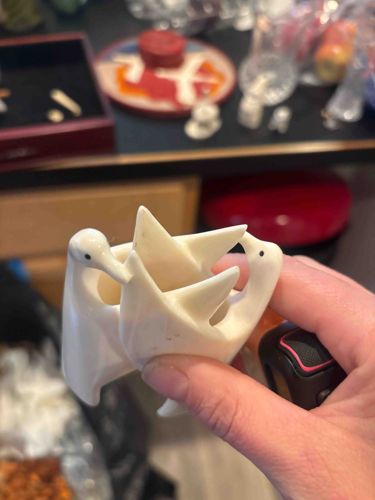
This item is an ivory carving, likely crafted from walrus tusk, and features a trio of stylized bird-like figures, possibly geese or swans, arranged in an interlocking, almost continuous design. The carving exhibits a smooth, polished surface with a creamy white to very light off-white natural color, indicative of aged ivory. The three figures are abstractly rendered, emphasizing their necks, heads, and wings, with minimal detail, except for small, dark specks representing eyes on the two visible heads. The carving displays fluid lines and a sense of motion, with the birds appearing to be in flight or gliding. Its construction suggests it was carved from a single piece of material, showcasing skilled craftsmanship in achieving the openwork and interconnected forms without breakage. The visible condition appears good, with no obvious signs of major damage like cracks or chips; however, slight surface discoloration or patina might be present due to age and handling. The size is compact, fitting comfortably within a hand, suggesting it could be a smaller decorative object or part of a larger composition. Given the context of 'Koguk ivory carving,' this piece likely originates from an Arctic or Inuit cultural tradition, renowned for their intricate ivory sculpture. The quality of the carving, evidenced by the smooth finish and well-executed forms, points to a skilled artisan. This piece embodies characteristics typical of mid-20th century to contemporary Inuit or Alaskan Native art, often featuring animal motifs and natural materials.
AI Appraisal Report
Based on my visual examination of the provided image, this ivory carving of three stylized birds appears to be in very good condition. The smooth, polished surface and creamy white color with minimal noticeable flaws suggest careful handling over time. The craftsmanship, particularly the fluid lines and interconnected forms carved from a single piece, indicates a skilled artisan. Authenticity, based solely on the image and the 'Koguk ivory carving' description, points strongly towards it being an Inuit or Alaskan Native piece, likely walrus ivory. The style aligns with traditional Arctic animal motifs, emphasizing their flight or gliding motion.
However, it is crucial to note that a definitive authenticity verification from images alone is limited. An in-person examination would allow me to assess the material's specific texture, weight, and subtle aged patina, which are difficult to discern precisely in photographs. Furthermore, scientific testing (e.g., radiocarbon dating or spectroscopic analysis) could confirm the specific ivory type and age, and direct provenance documentation (e.g., artist signature, date, original purchase receipts) would be paramount for full authentication and establishing its historical context. Without these, the 'Koguk' attribution remains based on style and visual cues.
In terms of market conditions, Inuit ivory carvings, especially those demonstrating good craftsmanship and artistic merit, maintain a steady demand. While not exceedingly rare, pieces that showcase unique designs and are in excellent condition are highly sought after by collectors of ethnographic art. Comparables in the market for similar mid-20th century to contemporary Inuit carvings of this size and quality typically range from $500 to $1,000. Factors significantly impacting its value include its excellent condition, the artistic quality of the carving, and the cultural attribution. Should in-person examination or testing confirm it to be an early, well-documented work by a known 'Koguk' artist, its value could appreciate significantly. Given the current information, my appraisal value is a conservative estimate.