AI Appraisal Estimate

AI-generated estimates · not official valuations

From the user

What was submitted

Photo and notes provided by the user — not generated by AI

Submitted item photo
Submitted photo · June 25, 2026

User's notes

No additional notes provided.

AI analysis below

AI appraisal

AI analysis & estimate

AI-Generated · Verify before acting

Everything below is generated by AI for informational purposes only. AI can make mistakes — the AI may misidentify items or misattribute them (artist, maker, brand, designer, origin, era). This is not an official valuation and should not be used for insurance, sale, tax, estate, legal, or lending purposes — or any decision requiring a certified appraisal. It is not an authoritative claim about any person, brand, or rights holder — do not share or rely on it as a factual statement about a third party. Always consult qualified professionals before making financial decisions.

Read the full disclaimer

AI Identification

·Not independently authenticated·Verify before acting

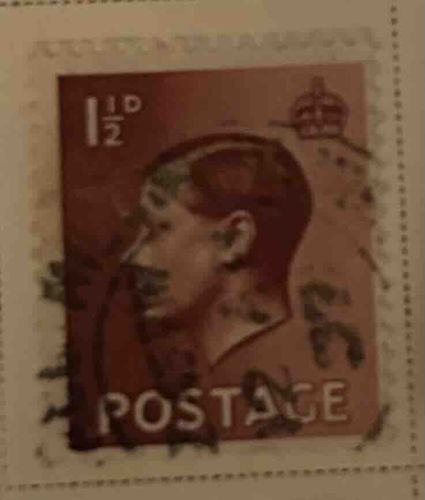
King George VI 1½d Postage Stamp

Postage Stamp

AI Estimated Value

·Not an official valuation·Verify before acting

$0.05 - $0.25

As of June 25, 2026

AI Item Analysis

·AI can make mistakes·Verify before acting
This item is a vintage postage stamp featuring a profile portrait of King George VI, likely from the mid-20th century, specifically his reign (1936-1952). The stamp is predominantly reddish-brown or sepia-toned, with the King's portrait depicted in a darker shade or with more distinct lines. In the upper left corner, the denomination '1½D' is visible, signifying one and a half pence. The 'D' typically stands for 'denarius' in pre-decimal British currency. In the upper right corner, there is a crown emblem, indicative of the British monarchy. The word 'POSTAGE' is clearly printed in capital letters along the bottom edge of the stamp. The stamp exhibits a perforated edge, which is standard for postage stamps, suggesting it was part of a larger sheet before being separated. The visible condition shows some minor wear and possibly some ink cancellation marks across the King's face and in other areas, indicating it has likely been used. The paper appears to be slightly discolored with age, and the perforation might have some irregularities due to handling or the initial separation process. The craftsmanship appears to be typical of early to mid-20th-century philatelic production, with a clear, if somewhat faded, intaglio or lithographic print. There are no obvious maker's marks or additional unique identifiers visible in the image beyond the standard features of British stamps from this period. The overall quality suggests a mass-produced item, though its specific condition and any potential rarity could influence its value.
AI Appraisal Report

·AI can make mistakes·Verify before acting
This King George VI 1½d postage stamp, typically from the 1937-1952 definitive issue, shows clear signs of having been used, indicated by the cancellation marks across the King's portrait. The reddish-brown coloration and 'POSTAGE' along the bottom are consistent with this common issue. Its perforated edges are standard. While the image suggests minor wear and age-related discoloration, which is typical for a stamp of this vintage that has been in circulation, these elements contribute to its lower value. From a market perspective, these stamps were mass-produced in the hundreds of millions and are extremely common. There is very low demand for typical used examples, and they are readily available from numerous dealers. Rarer varieties exist (e.g., misprints, plate flaws, specific watermarks), but none are evident from the provided image. The primary factor impacting its low value is its commonality and used condition. Unused, mint condition examples would fetch slightly more, but still typically under a dollar. Limitations: Authenticity in terms of being a genuine King George VI stamp is easily verifiable from the image. However, specific varieties, paper nuances, gum condition (if mint), and precise cancellation details that might indicate a rare postmark would require in-person examination. For a common stamp like this, expensive scientific testing or extensive provenance documentation is not economically justified, as its value does not warrant such investment.

Get your items appraised

Instant estimates of your treasures with AI-powered appraisals

Browse More Appraisals